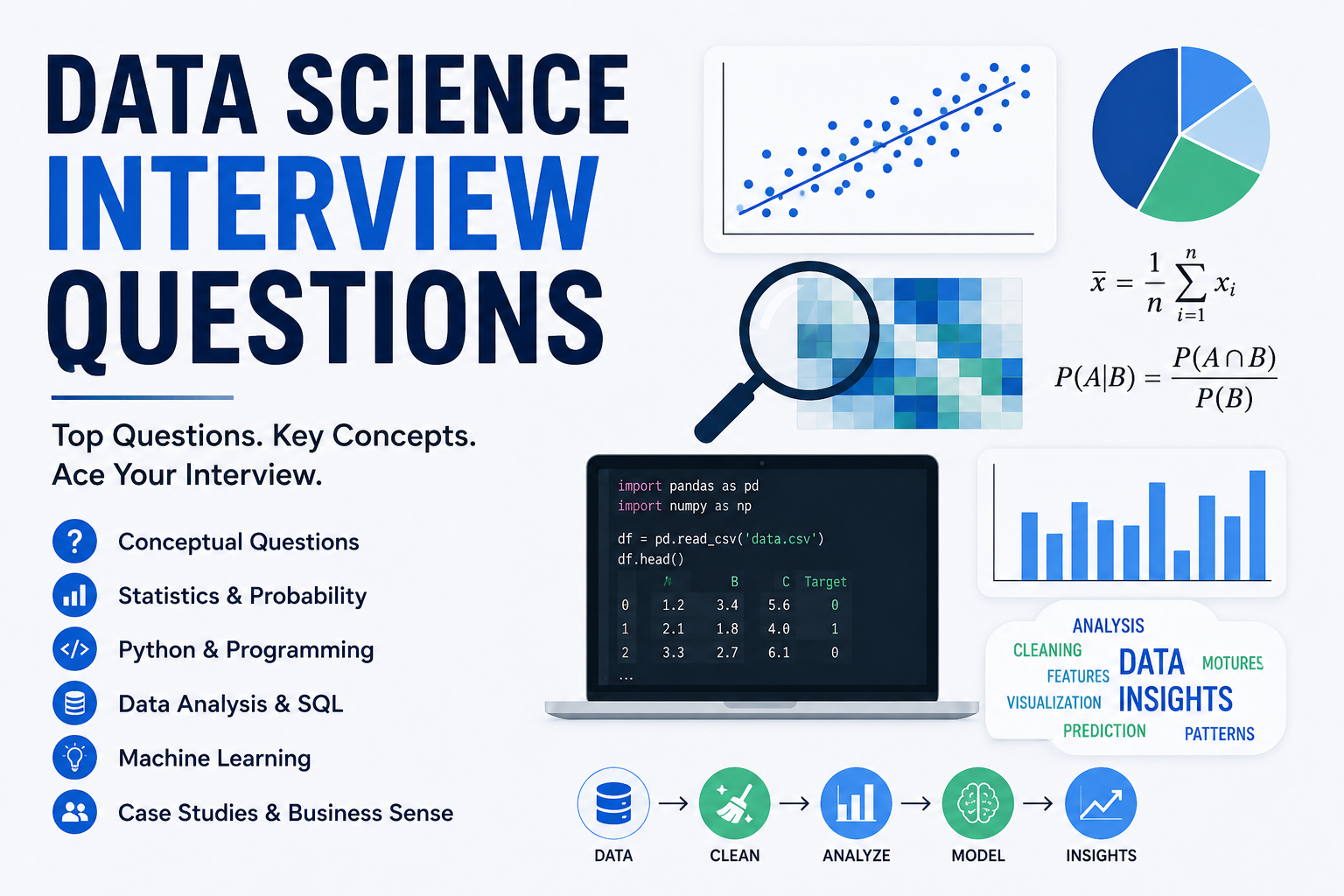
Data science interview questions are becoming more challenging as companies now test technical knowledge, business understanding, and problem-solving skills together. In a typical data science interview, candidates may face Python interview questions, SQL interview questions for data science, machine learning interview questions, statistics concepts, and scenario-based business cases in the same round.
Many candidates prepare only theoretical concepts and struggle to answer practical interview questions confidently. Interviewers today expect clear explanations, structured thinking, and real-world examples instead of memorized definitions.
This guide covers the most important data science interview questions and answers for freshers and experienced professionals. You will learn commonly asked Python, SQL, machine learning, and statistics interview questions along with interview-ready answers that can help you prepare for technical rounds more effectively.
Basic Data Science Interview Questions
1. What Is Data Science?
Ans: Data science is the process of collecting, cleaning, analyzing, and interpreting data to solve business problems and support decision-making. It combines statistics, machine learning, programming, and domain knowledge.
Companies use data science to:
- Predict customer behavior
- Detect fraud
- Improve recommendations
- Analyze trends
- Automate business decisions
A simple example of data science is a shopping platform recommending products based on previous purchases and browsing activity.
2. Difference Between AI, Machine Learning, and Data Science
Ans: Artificial Intelligence, Machine Learning, and Data Science are related fields, but they are not the same.
Artificial Intelligence focuses on creating systems that can perform tasks that normally require human intelligence, such as understanding language, making decisions, or recognizing images.
Machine Learning is a subset of AI where systems learn patterns from data and improve performance without being explicitly programmed for every task.
Data Science is a broader field that focuses on collecting, cleaning, analyzing, and interpreting data to solve business problems. It uses machine learning, statistics, and data analysis techniques to extract useful insights from data.”
Example
- A virtual assistant like Siri is an example of Artificial Intelligence.
- Spam email filtering is an example of Machine Learning.
- Predicting future sales using customer data is an example of Data Science.
3. What Is Structured and Unstructured Data?
Ans: Structured data is organized in rows and columns, such as SQL databases or spreadsheets. Unstructured data does not follow a fixed format and includes images, videos, audio files, and social media content.
4. What Is Big Data?
Ans: Big data refers to large and complex datasets that traditional systems cannot process efficiently. It is usually defined using the 5 Vs: Volume, Velocity, Variety, Veracity, and Value.
5. What Is the Difference Between Supervised and Unsupervised Learning?
Ans: Supervised learning uses labeled data, which means the correct output is already known during training. The model learns the relationship between input and output data and then predicts results for new data.
Unsupervised learning uses unlabeled data where the output is not provided. The model identifies hidden patterns, relationships, or groupings within the data on its own.
6. What Is Overfitting in Machine Learning?
Ans: Overfitting happens when a machine learning model performs very well on training data but poorly on new unseen data. This occurs because the model memorizes the training data instead of learning general patterns.”
7. How Can You Reduce Overfitting?
Ans: Overfitting can be reduced using techniques like cross-validation, regularization, feature selection, and increasing training data. These methods help the model generalize better on unseen data.
8. What Is Machine Learning?
Ans: Machine learning is a branch of artificial intelligence where systems learn patterns from data and make predictions without being explicitly programmed. It is commonly used in recommendation systems, fraud detection, spam filtering, and predictive analytics.
9. What Is Feature Engineering?
Ans: Feature engineering is the process of selecting, modifying, or creating input variables that improve machine learning model performance. Good feature engineering helps models identify patterns more accurately.
10. What Is Data Cleaning?
Ans: Data cleaning is the process of fixing or removing incorrect, duplicate, incomplete, or inconsistent data from a dataset. Clean data improves analysis quality and machine learning model accuracy.
11. What Is Cross Validation?
Ans: Cross validation is a technique used to evaluate machine learning models by dividing data into multiple subsets for training and testing. It helps check how well the model performs on unseen data.
12. What Is the Difference Between Regression and Classification?
Ans: Regression predicts continuous numerical values, while classification predicts categories or labels.
Examples:
- Regression: Predicting house prices
- Classification: Spam email detection
13. What Is Bias and Variance in Machine Learning?
Ans: Bias occurs when a model makes overly simple assumptions and misses important patterns in data. Variance occurs when a model becomes too sensitive to training data and performs poorly on new data.
14. What Is Training Data and Test Data?
Ans: Training data is used to train machine learning models, while test data is used to evaluate model performance on unseen data.
15. What Is Data Wrangling?
Ans: Data wrangling is the process of transforming raw data into a structured and usable format for analysis. It includes cleaning, organizing, and preparing data for machine learning or reporting.
16. What Are the Main Components of Data Science?
Ans: The main components of data science include:
- Data collection
- Data cleaning
- Data analysis
- Data visualization
- Machine learning
- Model deployment
These components help businesses extract meaningful insights from data.
Intermediate Data Science Interview Questions and Answers
17. What Is a Confusion Matrix?
Ans: A confusion matrix is a table used to evaluate classification model performance. It shows true positives, true negatives, false positives, and false negatives.
18. What Is Precision in Machine Learning?
Ans: Precision measures how many predicted positive values are actually correct. It is important when false positives are costly.
Precision= TP/TP+FP
19. What Is Recall in Machine Learning?
Ans: Recall measures how many actual positive cases are correctly identified by the model. It is important when missing positive cases is risky.
20. What Is F1 Score?
Ans: F1 Score is the harmonic mean of precision and recall. It is useful for evaluating imbalanced classification problems.
21. What Is a Decision Tree?
Ans: A decision tree is a supervised machine learning algorithm used for classification and regression. It splits data into branches based on feature conditions.
22. What Is Random Forest?
Ans: Random Forest is an ensemble learning algorithm that combines multiple decision trees to improve prediction accuracy and reduce overfitting.
23. What Is Logistic Regression?
Ans: Logistic regression is a supervised learning algorithm used for classification problems. It predicts probabilities between 0 and 1.
24. What Is Linear Regression?
Ans: Linear regression is a supervised learning algorithm used to predict continuous numerical values based on relationships between variables.
25. What Is Feature Selection?
Ans: Feature selection is the process of selecting the most important input variables for machine learning models to improve accuracy and reduce complexity.
26. What Is Dimensionality Reduction?
Ans: Dimensionality reduction is the process of reducing the number of input features while preserving important information from the dataset.
27. What Is PCA in Data Science?
Ans: PCA, or Principal Component Analysis, is a dimensionality reduction technique used to transform high-dimensional data into fewer components while retaining maximum variance.
28. What Is Hyperparameter Tuning?
Ans: Hyperparameter tuning is the process of finding the best parameter values for machine learning models to improve performance.
29. What Is ROC-AUC?
Ans: ROC-AUC is a performance metric used for classification models. It measures how well the model separates different classes.
30. What Is Gradient Descent?
Ans: Gradient descent is an optimization algorithm used to minimize model error by updating model parameters step by step.
31. What Is Regularization?
Ans: Regularization is a technique used to reduce overfitting by adding penalties to machine learning models.
32. What Is the Difference Between L1 and L2 Regularization?
Ans: L1 regularization reduces less important feature weights to zero, while L2 regularization reduces weights gradually without making them exactly zero.
| Regularization | Purpose |
| L1 Regularization | Feature selection |
| L2 Regularization | Weight reduction |
33. What Is Clustering in Machine Learning?
Ans: Clustering is an unsupervised learning technique used to group similar data points together based on patterns and similarities.
34. What Is K-Means Clustering?
Ans: K-Means is a clustering algorithm that divides data into K groups based on similarity and distance from cluster centers.
35. What Is Data Leakage?
Ans: Data leakage happens when information from outside the training dataset is accidentally used during model training, leading to unrealistic model performance.
36. What Is Class Imbalance in Machine Learning?
Ans: Class imbalance occurs when one category in the dataset has significantly more samples than another category, which can affect model performance.
Advanced Data Science Interview Questions and Answers
37. What Is XGBoost?
Ans: XGBoost is an advanced gradient boosting algorithm designed for high performance and speed. It is widely used in machine learning competitions and real-world predictive modeling tasks.
38. What Is Ensemble Learning?
Ans: Ensemble learning is a technique that combines multiple machine learning models to improve prediction accuracy and reduce errors.
Examples:
- Random Forest
- Gradient Boosting
- AdaBoost
39. What Is Bagging and Boosting?
Ans: Bagging trains multiple models independently and combines their outputs, while boosting trains models sequentially where each new model corrects previous errors.
| Technique | Working Method |
| Bagging | Parallel learning |
| Boosting | Sequential learning |
40. What Is Gradient Boosting?
Ans: Gradient boosting is an ensemble learning method where models are built one after another to reduce prediction errors from previous models.
41. What Is the Bias-Variance Tradeoff?
Ans: The bias-variance tradeoff refers to balancing underfitting and overfitting in machine learning models to achieve better generalization.
42. What Is A/B Testing?
Ans: A/B testing is a statistical method used to compare two versions of a product, webpage, or feature to determine which performs better.
43. What Is Data Drift in Machine Learning?
Ans: Data drift occurs when the statistical properties of incoming data change over time, causing machine learning model performance to decrease.
44. What Is Concept Drift?
Ans: Concept drift happens when the relationship between input variables and target variables changes over time.
45. What Is the Difference Between Type I and Type II Errors?
Ans: Type I error occurs when a true null hypothesis is rejected, while Type II error occurs when a false null hypothesis is accepted.
46. What Is P-Value in Statistics?
Ans: A p-value measures the probability of obtaining results by chance if the null hypothesis is true. Smaller p-values usually indicate stronger statistical significance.
47. What Is Hypothesis Testing?
Ans: Hypothesis testing is a statistical method used to determine whether there is enough evidence to support a specific assumption about data.
48. What Is Multicollinearity?
Ans: Multicollinearity occurs when independent variables in a dataset are highly correlated with each other, which can affect model performance.
49. What Is SMOTE?
Ans: SMOTE, or Synthetic Minority Oversampling Technique, is used to handle imbalanced datasets by generating synthetic samples for minority classes.
50. What Is NLP in Data Science?
Ans: Natural Language Processing, or NLP, is a field of artificial intelligence that helps machines understand, process, and analyze human language.
Applications:
- Chatbots
- Sentiment analysis
- Language translation
51. What Is Time Series Analysis?
Ans: Time series analysis involves analyzing data collected over time to identify patterns, trends, and seasonality.
52. What Is ARIMA Model?
Ans: ARIMA is a statistical model used for time series forecasting based on autoregression, differencing, and moving averages.
53. What Is Reinforcement Learning?
Ans: Reinforcement learning is a machine learning approach where an agent learns by interacting with an environment and receiving rewards or penalties.
54. What Is Feature Importance?
Ans: Feature importance identifies which input variables contribute the most to machine learning model predictions.
55. What Is Model Deployment?
Ans: Model deployment is the process of making a trained machine learning model available for real-world use in applications or systems.
Python Interview Questions for Data Science
56. Why Do Data Scientists Prefer Python?
Ans: Python is one of the most preferred programming languages in data science because it is easy to learn, supports powerful libraries, and helps handle data analysis, machine learning, automation, and visualization efficiently.
57. What Is the Difference Between Lists and Tuples in Python?
Ans: Lists are mutable, meaning their values can be changed after creation, while tuples are immutable and cannot be modified. Tuples are generally faster and more memory efficient than lists.
58. How Are NumPy and Pandas Different?
Ans: NumPy is mainly used for numerical computing and array operations, whereas Pandas is designed for data manipulation, cleaning, and analysis using DataFrames and tabular datasets.
59. What Are Lambda Functions in Python?
Ans: Lambda functions are small anonymous functions written in a single line using the lambda keyword. They are commonly used for short operations such as filtering, mapping, and sorting data.
60. How Do You Handle Missing Values in a Dataset Using Python?
Ans: Missing values can be handled by removing incomplete rows, replacing missing values with mean or median values, or using interpolation techniques depending on the dataset and business requirement. Libraries like Pandas provide functions such as fillna() and dropna() for handling missing data.
SQL Interview Questions for Data Science
61. What Is SQL and Why Is It Important in Data Science?
Ans: SQL, or Structured Query Language, is used to store, manage, retrieve, and analyze data from relational databases. Data scientists use SQL to extract insights, clean datasets, and work with large volumes of business data efficiently.
62. What Is the Difference Between WHERE and HAVING in SQL?
Ans: The WHERE clause filters individual rows before aggregation takes place, while the HAVING clause filters grouped data after aggregate functions like COUNT or SUM are applied.
63. What Is a JOIN in SQL?
Ans: A JOIN is used to combine data from multiple tables based on related columns. It helps retrieve connected information stored across different database tables.
64. What Is the Purpose of GROUP BY in SQL?
Ans: GROUP BY is used to organize rows with similar values into groups so aggregate functions like COUNT, SUM, AVG, MAX, and MIN can be applied to each group.
65. What Is the Difference Between UNION and UNION ALL?
Ans: UNION combines results from multiple queries and removes duplicate rows, while UNION ALL combines all rows including duplicates and usually performs faster.
Scenario-Based Data Science Interview Questions and Answers
66. How Would You Handle Missing Data in a Large Dataset?
Ans: First, I would analyze the percentage and pattern of missing values. If the missing data is small, I may remove those rows. For important columns, I would use techniques like mean, median, mode, or interpolation depending on the data type and business problem.
67. What Would You Do If Your Machine Learning Model Performs Well on Training Data but Poorly on Test Data?
Ans: This usually indicates overfitting. I would reduce model complexity, use cross-validation, apply regularization techniques, perform feature selection, or increase training data to improve generalization.
68. How Would You Improve Customer Retention for an E-Commerce Company?
Ans: I would analyze customer purchase history, browsing behavior, and feedback data to identify patterns related to customer churn. Then I would build predictive models to identify at-risk customers and recommend personalized offers or retention strategies.
69. Suppose Your Dataset Is Highly Imbalanced. How Would You Handle It?
Ans: I would use techniques like oversampling, undersampling, SMOTE, or class weighting to balance the dataset. I would also focus on evaluation metrics like F1-score, precision, and recall instead of only accuracy.
70. How Would You Detect Fraudulent Transactions?
Ans: I would analyze transaction patterns, unusual user behavior, transaction frequency, and location-based anomalies. Machine learning classification models like Random Forest or XGBoost can help identify suspicious transactions.
71. A Stakeholder Wants Faster Results but Your Model Accuracy Is Low. What Would You Do?
Ans: I would explain the tradeoff between speed and accuracy clearly. Then I would deliver a simpler baseline model first and continue improving performance using feature engineering and tuning techniques.
72. How Would You Explain a Complex Machine Learning Model to a Non-Technical Client?
Ans: I would avoid technical jargon and explain the model using simple business examples, visualizations, and practical outcomes. The focus would be on business impact rather than mathematical details.
73. What Would You Do If Your Data Contains Outliers?
Ans: First, I would identify whether the outliers are valid or due to data errors. Depending on the situation, I may remove them, cap extreme values, or use robust statistical techniques.
74. How Would You Build a Recommendation System for a Shopping Website?
Ans: I would analyze user purchase history, browsing patterns, product ratings, and similarities between users or products. Collaborative filtering and content-based filtering techniques are commonly used for recommendation systems.
75. How Would You Predict Customer Churn?
Ans: I would collect customer behavior data such as usage frequency, complaints, subscription history, and engagement levels. Then I would build a classification model to identify customers likely to leave.
How to Prepare for Data Science Interviews
- Build strong fundamentals in Python, SQL, statistics, and machine learning
- Practice commonly asked data science interview questions regularly
- Work on real-world projects to improve practical understanding
- Learn important SQL concepts like joins, subqueries, and aggregation
- Practice scenario-based questions to improve problem-solving skills
- Revise machine learning metrics like precision, recall, accuracy, and F1-score
- Improve communication skills so you can explain concepts clearly in interviews
- Practice mock interviews to gain confidence and improve answer structure
Conclusion
Data science interviews test technical knowledge, analytical thinking, coding ability, and real-world problem-solving skills. Companies expect candidates to explain concepts clearly and apply them in practical situations. Preparing Python, SQL, machine learning, statistics, and scenario-based interview questions can help you perform confidently during technical rounds. Consistent practice, strong fundamentals, and project experience play an important role in cracking data science interviews successfully.