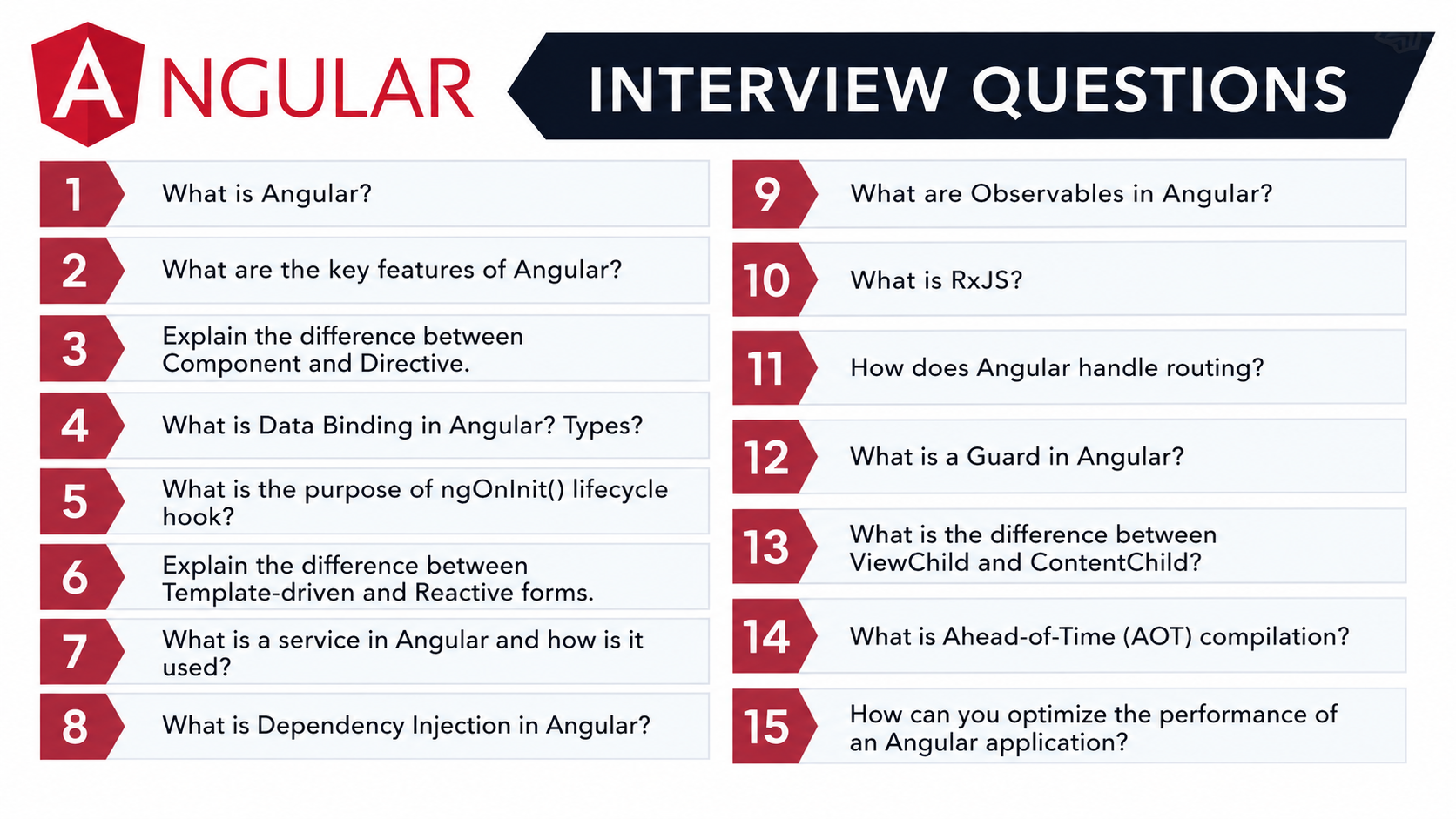
Angular is one of the most widely used front-end frameworks for developing modern, scalable, and feature-rich web applications. Built and maintained by Google, Angular offers a robust ecosystem that helps developers create dynamic user interfaces with improved performance and maintainability. As the demand for Angular developers continues to grow, companies are increasingly focusing on technical interviews to evaluate candidates’ knowledge of Angular fundamentals, architecture, and real-world problem-solving skills. Whether you are a fresher preparing for your first job or an experienced developer targeting a senior position, understanding common Angular interview questions can help you build confidence and improve your chances of success in competitive interviews.
Angular Interview Questions for Freshers
1. What is Angular?
A: Angular is a TypeScript-based open-source front-end framework developed by Google. It is used to build dynamic, scalable, and single-page web applications (SPAs). Angular follows a component-based architecture that makes application development and maintenance easier.
2. What are the key features of Angular?
A: Some important features of Angular include:
- Component-based architecture
- Two-way data binding
- Dependency injection
- Routing and navigation
- TypeScript support
- Directives and pipes
- Lazy loading
- Form handling
- Built-in testing tools
3. What is the difference between Angular and AngularJS?
A:
| Angular | AngularJS |
| Uses TypeScript | Uses JavaScript |
| Component-based architecture | MVC architecture |
| Better performance | Comparatively slower |
| Mobile-friendly | Limited mobile support |
| Improved dependency injection | Basic dependency injection |
4. What is a Component in Angular?
A: A component is the fundamental building block of an Angular application. It controls a portion of the user interface and contains:
- HTML template
- TypeScript class
- CSS styles
Every Angular application consists of multiple components working together.
5. What is a Module in Angular?
A: A module is a container that groups related components, directives, pipes, and services. Modules help organize the application into logical sections. The root module in Angular is usually called AppModule.
6. What is TypeScript, and why is it used in Angular?
A: TypeScript is a superset of JavaScript that adds features like static typing, interfaces, classes, and decorators. Angular uses TypeScript because it improves code quality, maintainability, and development productivity.
7. What is Data Binding in Angular?
A: Data binding is a technique that synchronizes data between the component and the view. It allows information to flow automatically between the user interface and application logic.
8. What are the different types of Data Binding?
A: Angular supports four types of data binding:
- Interpolation ({{ }})
- Property Binding ([])
- Event Binding (())
- Two-Way Binding ([()])
9. What is Interpolation?
A: Interpolation is used to display component data inside HTML templates using double curly braces.
Example:
<h2>{{ title }}</h2>
10. What is Property Binding?
A: Property binding allows you to bind component data to HTML element properties.
Example:
<img [src]=”imageUrl”>
11. What is Event Binding?
A: Event binding allows Angular to respond to user actions such as clicks, keyboard events, or mouse movements.
Example:
<button (click)=”saveData()”>Save</button>
When the button is clicked, the specified method is executed.
12. What is Two-Way Data Binding?
A: Two-way data binding keeps the component and view synchronized automatically. It is commonly used with forms through the ngModel directive.
<input [(ngModel)]=”username”>
Changes in the input field instantly update the component variable and vice versa.
13. What are Directives in Angular?
A: Directives are instructions that tell Angular how to modify the appearance or behavior of elements in the DOM. They help create dynamic and reusable UI behavior.
14. What are the different types of Directives?
A: Angular provides three main types of directives:
- Component Directives – Directives with templates.
- Structural Directives – Change DOM structure.
- Attribute Directives – Change element appearance or behavior.
Examples:
- *ngIf
- *ngFor
- [ngClass]
- [ngStyle]
15. What is the difference between *ngIf and *ngFor?
A:
| *ngIf | *ngFor |
| Conditionally displays elements | Repeats elements |
| Works with Boolean values | Works with arrays or collections |
| Shows or hides content | Generates multiple elements |
16. What is Dependency Injection in Angular?
A: Dependency Injection (DI) is a design pattern that allows Angular to provide required services automatically to components and other classes.
Benefits include:
- Better code reusability
- Loose coupling
- Easier testing
- Improved maintainability
17. What is a Service in Angular?
A: A service is a class that contains reusable business logic, API calls, or shared functionality. Services help keep components clean and focused on UI-related tasks.
18. What is Angular CLI?
A: Angular CLI (Command Line Interface) is a powerful tool that simplifies Angular development.
Common commands include:
ng new my-app
ng serve
ng generate component home
ng build
CLI helps automate development tasks and improve productivity.
19. What are Pipes in Angular?
A: Pipes are used to transform and format data before displaying it in the template.
Common built-in pipes include:
- DatePipe
- CurrencyPipe
- UpperCasePipe
- LowerCasePipe
- PercentPipe
Example:
{{ today | date }}
20. What is Routing in Angular?
A: Routing allows users to navigate between different views or pages within a single-page application without reloading the entire page.
Benefits of Angular Routing:
- Faster navigation
- Better user experience
- Bookmarkable URLs
- Lazy loading support
- Organized application structure
Angular uses the RouterModule to define and manage application routes.
Angular Interview Questions for 5 Years Experience
1. How would you structure a large-scale Angular application?
A: A large Angular application should be organized using feature modules, shared modules, and core modules. Business features should be separated into independent modules, while reusable components and services should be placed in shared and core modules. This approach improves maintainability, scalability, and code reusability.
2. What is Lazy Loading, and why is it important?
A: Lazy loading is a technique that loads feature modules only when they are required. Instead of loading the entire application at startup, Angular loads specific modules when users navigate to them.
Benefits:
- Faster initial loading time
- Better performance
- Reduced bundle size
- Improved user experience
3. What is the difference between a Shared Module and a Core Module?
A:
| Shared Module | Core Module |
| Contains reusable components, directives, and pipes | Contains singleton services |
| Imported in multiple modules | Imported only once in AppModule |
| Focuses on UI reusability | Focuses on application-wide functionality |
4. What is Change Detection in Angular?
A: Change Detection is Angular’s mechanism for tracking changes in application data and updating the DOM automatically whenever the data changes. Angular checks component properties and updates the UI whenever a change occurs.
5. What is the OnPush Change Detection Strategy?
A: OnPush is an optimized change detection strategy that updates a component only when:
- An input reference changes
- An event occurs inside the component
- An Observable emits a new value
It significantly improves performance in large applications.
6. What is State Management in Angular?
A: State management refers to handling application data consistently across multiple components.
Common approaches include:
- Services with RxJS
- BehaviorSubject
- Signals
- NgRx
- Akita
- NGXS
7. What is NgRx?
A: NgRx is a Redux-inspired state management library for Angular. It helps manage complex application states using a centralized store.
Main components include:
- Store
- Actions
- Reducers
- Effects
- Selectors
8. What are Actions in NgRx?
A: Actions are events that describe changes in the application’s state.
Example:
export const loadUsers = createAction(‘[User] Load Users’);
Actions help trigger state updates and side effects.
9. What are Selectors in NgRx?
A: Selectors are pure functions used to retrieve specific pieces of data from the store efficiently. They improve performance by avoiding unnecessary recalculations.
10. What are Effects in NgRx?
A: Effects handle asynchronous operations such as:
- API calls
- Database requests
- External service communication
They keep components and reducers free from side-effect logic.
11. What is a Resolver in Angular Routing?
A: A Resolver fetches data before a route is activated. This ensures the required data is available before the component loads, resulting in a smoother user experience.
12. How do you secure an Angular application?
A: Common security practices include:
- JWT authentication
- Route Guards
- HTTPS communication
- Input validation
- Content Security Policy (CSP)
- XSS protection
- CSRF prevention
- API authorization
13. What is XSS, and how does Angular prevent it?
A: Cross-Site Scripting (XSS) is a security vulnerability where malicious scripts are injected into web pages.
Angular automatically sanitizes:
- HTML
- URLs
- Resource URLs
- Styles
This helps protect applications from XSS attacks.
14. What is Angular Universal?
A: Angular Universal enables Server-Side Rendering (SSR) for Angular applications.
Benefits include:
- Better SEO
- Faster page rendering
- Improved Core Web Vitals
- Better user experience
15. What is Tree Shaking?
A: Tree shaking is a build optimization process that removes unused code from the final bundle.
Benefits include:
- Smaller bundle size
- Faster loading
- Better application performance
16. What is Content Projection in Angular?
A: Content projection allows developers to insert external content into a component using the <ng-content> element.
It improves component reusability and flexibility.
Example:
<ng-content></ng-content>
17. What is trackBy in ngFor?
A: trackBy helps Angular identify items uniquely when rendering lists. Without trackBy, Angular recreates all DOM elements whenever data changes. Using trackBy improves performance significantly.
Example:
trackById(index: number, item: any) {
return item.id;
18. What are Standalone Components in Angular?
A: Standalone Components eliminate the need for NgModules.
Benefits include:
- Simpler code structure
- Reduced boilerplate code
- Faster development
- Better maintainability
They are widely used in modern Angular versions.
19. How do you optimize the performance of an Angular application?
A: Common optimization techniques include:
- Lazy Loading
- OnPush Change Detection
- AOT Compilation
- Tree Shaking
- trackBy Function
- Virtual Scrolling
- Efficient RxJS usage
- Image optimization
- Caching API responses
20. How would you handle memory leaks in Angular?
A: Memory leaks often occur due to active subscriptions that are not properly cleaned up.
Best practices include:
- Unsubscribing in ngOnDestroy
- Using Async Pipe
- Using takeUntil
- Using take(1) where applicable
- Removing event listeners when components are destroyed
Proper subscription management helps maintain application performance and prevents unnecessary memory consumption.
Angular Interview Questions for 10 Years Experience
1. How would you architect a large enterprise Angular application?
A: I would follow a feature-based architecture with clear separation of concerns. The application would be divided into Core, Shared, and Feature Modules. Shared functionality would be isolated into reusable libraries, while business domains would be developed independently. I would also implement state management, lazy loading, API abstraction layers, centralized error handling, and CI/CD pipelines to ensure scalability and maintainability.
2. How do you decide whether a project needs NgRx or simple service-based state management?
A: The decision depends on application complexity.
- For small to medium applications, RxJS services and BehaviorSubjects are usually sufficient.
- For large enterprise applications with shared state across multiple modules, NgRx provides better predictability, debugging capabilities, and maintainability.
Choosing NgRx unnecessarily can increase complexity, so I evaluate project size and business requirements before making the decision.
3. How would you improve the performance of an Angular application with thousands of users?
A: I would improve performance by implementing OnPush Change Detection, lazy-loaded modules, virtual scrolling, route preloading, bundle optimization, server-side rendering, API caching, and optimized RxJS subscriptions. I would also use performance monitoring tools such as Lighthouse, Chrome DevTools, and Angular DevTools to identify and resolve bottlenecks.
4. What challenges have you faced while upgrading Angular versions?
A: The most common challenges during Angular upgrades include breaking changes, dependency conflicts, third-party package incompatibilities, TypeScript version mismatches, and outdated code patterns. To minimize risks, I prefer upgrading incrementally, following Angular’s migration guidelines, and performing thorough testing before deployment.
5. How would you implement a Micro Frontend architecture in Angular?
A: I would implement Micro Frontends using Webpack Module Federation, which allows different parts of an application to be developed and deployed independently. This approach supports team autonomy, faster releases, and better scalability, especially in large enterprise environments.
6. How do you design reusable Angular components for enterprise applications?
A: I design reusable components by keeping them configurable, loosely coupled, and independent of business-specific logic. Components should accept data through Inputs, communicate through Outputs, follow accessibility standards, and be properly tested to ensure they can be reused across multiple projects and modules.
7. What are the most common performance issues in Angular applications?
A: Common performance issues include excessive change detection cycles, inefficient ngFor rendering, large bundle sizes, memory leaks from subscriptions, unnecessary API requests, and poorly managed application state. Identifying and optimizing these areas can significantly improve application performance.
8. How would you handle memory leaks in Angular?
A: I handle memory leaks by properly managing subscriptions, using the Async Pipe where possible, implementing takeUntil(), cleaning resources in ngOnDestroy(), and removing unused event listeners. Regular performance profiling also helps identify potential memory-related issues before they affect users.
9. What is your approach to Angular application security?
A: My security approach includes implementing JWT authentication, role-based authorization, route guards, HTTPS communication, input validation, secure token handling, and protection against XSS attacks. I also ensure that critical authorization checks are enforced on the backend rather than relying solely on the frontend.
10. How would you implement Role-Based Access Control (RBAC) in Angular?
A: I would store user roles after authentication and use route guards, permission services, and custom directives to restrict access to features based on user roles. While Angular controls the user interface, all role validations should also be enforced on the server side for security.
11. How would you handle a situation where Angular change detection becomes a bottleneck?
A: I would reduce unnecessary change detection by using the OnPush strategy, implementing trackBy functions for lists, splitting large components into smaller ones, minimizing bindings, and using modern Angular features such as Signals when appropriate. These optimizations help improve rendering efficiency.
12. What is Angular Universal, and when would you recommend it?
A: Angular Universal is Angular’s Server-Side Rendering solution that generates HTML on the server before sending it to the browser. I recommend it for SEO-focused websites, e-commerce platforms, blogs, and content-heavy applications where fast page loading and search engine visibility are important.
13. How do you approach API architecture in Angular projects?
A: I prefer creating a dedicated API layer using services and HTTP interceptors. This approach centralizes API communication, error handling, authentication management, caching, logging, and retry mechanisms. It improves maintainability and ensures consistency throughout the application.
14. How would you manage a team working on a large Angular codebase?
A: I would establish coding standards, conduct regular code reviews, maintain proper documentation, and encourage the use of reusable components and shared libraries. Automated testing and CI/CD pipelines would help ensure consistent code quality and smooth deployments across the team.
15. What is your strategy for testing enterprise Angular applications?
A: I follow a layered testing approach that includes unit testing, component testing, integration testing, and end-to-end testing. Automated tests are integrated into the CI/CD pipeline to identify issues early and improve release reliability.
16. How do you ensure Angular applications remain maintainable over several years?
A: I focus on modular architecture, clean coding practices, proper documentation, regular dependency updates, and continuous refactoring. This helps reduce technical debt and keeps the application scalable and easy to maintain.
17. What architectural patterns do you commonly use in Angular?
A: I commonly use Container-Presenter, Smart and Dumb Components, Facade, Repository, and Service patterns. These patterns improve code organization, reusability, and maintainability in large applications.
18. How would you monitor and troubleshoot production Angular applications?
A: I use monitoring tools such as Sentry, New Relic, and Datadog to track errors and performance issues. Logs, analytics, and performance metrics help identify and resolve problems quickly.
19. What qualities differentiate a Senior Angular Developer from a Mid-Level Developer?
A: A senior developer focuses on architecture, scalability, security, performance optimization, and mentoring team members. They make strategic technical decisions and ensure long-term project success.
20. What is the most important consideration when building enterprise Angular applications?
A: The most important consideration is balancing scalability, maintainability, performance, and security. The application should be easy to extend, support growing user demands, and align with long-term business goals.
Angular Scenario Based Interview Questions
Scenario-based Angular interview questions are designed to evaluate how you apply Angular concepts in real-world situations. Instead of testing theoretical knowledge, these questions assess your problem-solving skills, architectural thinking, and ability to handle challenges commonly encountered in enterprise applications.
1. A component is making multiple API calls every time a user navigates to the page. How would you optimize it?
A: I would first identify why the API is being called repeatedly. If the data does not change frequently, I would cache the response using a service or state management solution. I might also use route resolvers to preload data before navigation and avoid unnecessary requests.
2. Your Angular application becomes slow when displaying thousands of records in a table. What would you do?
A: I would implement virtual scrolling using Angular CDK to render only visible records. Additionally, I would use pagination, lazy loading, and trackBy functions in ngFor to reduce DOM rendering overhead.
3. A user refreshes the browser and loses all application data. How would you solve this?
A: I would persist important data using localStorage, sessionStorage, IndexedDB, or a state management solution. This ensures that essential information remains available even after a page refresh.
4. Multiple components need access to the same data. How would you share it?
A: I would create a shared service and use RxJS Subjects or BehaviorSubjects to manage and distribute the data. For larger applications, I might use NgRx or Signals for centralized state management.
5. A page takes too long to load because of a large feature module. What is your solution?
A: I would implement lazy loading so that the module loads only when the user accesses it. This reduces the application’s initial bundle size and improves startup performance.
6. You need to restrict certain pages to administrators only. How would you implement this?
A: I would use Route Guards to check user roles before allowing navigation. Role information would be validated both on the frontend and backend to ensure security.
7. An API request fails due to network issues. How would you handle it?
A: I would implement centralized error handling using HTTP Interceptors and display user-friendly error messages. Retry mechanisms and fallback strategies could also be added where appropriate.
8. Users report memory issues after spending a long time in the application. What would you investigate?
A: I would inspect active subscriptions, event listeners, and dynamically created components. Memory profiling tools would help identify leaks, and I would ensure proper cleanup using ngOnDestroy and Async Pipes.
9. You need to display data before a route loads. How would you achieve this?
A: I would use Angular Route Resolvers to fetch the required data before the component is initialized. This prevents incomplete page rendering and improves the user experience.
10. A component contains too much business logic. How would you refactor it?
A: I would move business logic into dedicated services and keep the component focused on presentation. This improves maintainability, testability, and code reusability.
11. Your application experiences frequent duplicate API requests. How would you fix it?
A: I would review subscriptions and ensure APIs are not called unnecessarily. Techniques such as caching, shareReplay(), and proper state management can help prevent duplicate requests.
12. Users need real-time updates without refreshing the page. What approach would you use?
A: I would use WebSockets or Server-Sent Events (SSE) along with RxJS Observables to deliver real-time updates efficiently.
13. A large form becomes difficult to manage and maintain. How would you improve it?
A: I would use Reactive Forms, split the form into smaller reusable components, and implement custom validators to improve maintainability and scalability.
14. Your Angular application must support multiple languages. What would you do?
A: I would implement internationalization (i18n) using Angular’s built-in localization features or libraries such as ngx-translate to manage translations effectively.
15. The application needs offline support. How would you implement it?
A: I would use Service Workers and Progressive Web App (PWA) capabilities to cache assets and data, allowing users to continue working even without an internet connection.
16. A feature is causing slow change detection across the application. How would you optimize it?
A: I would implement OnPush Change Detection, reduce unnecessary bindings, optimize component structures, and use trackBy functions to minimize rendering costs.
17. You need to load different dashboards based on user roles. How would you design this?
A: I would use role-based routing and dynamically load components or modules based on permissions. This ensures users only access features relevant to their roles.
18. The bundle size of your Angular application is becoming too large. What steps would you take?
A: I would implement lazy loading, tree shaking, code splitting, image optimization, and remove unused dependencies to reduce the final bundle size.
19. A third-party library is slowing down the application. How would you handle it?
A: I would analyze its impact using performance tools, load it only when necessary, find lighter alternatives if available, or create a custom solution if the overhead is significant.
20. Your team needs a consistent UI across multiple Angular applications. What would you suggest?
A: I would create a shared component library containing reusable UI components, themes, and design standards. This ensures consistency, reduces development time, and improves maintainability across projects.
Angular MCQ Questions (20 MCQs with Answers)
1. Which language is Angular primarily based on?
A) Java
B) Python
C) TypeScript
D) PHP
Answer: C) TypeScript
2. Which directive is used for two-way data binding in Angular?
A) ngIf
B) ngFor
C) ngModel
D) ngClass
Answer: C) ngModel
3. Which Angular directive is used for conditional rendering?
A) *ngFor
B) *ngIf
C) ngModel
D) ngSwitchCase
Answer: B) *ngIf
4. Which directive is used to iterate through a collection?
A) ngModel
B) *ngFor
C) *ngIf
D) ngStyle
Answer: B) *ngFor
5. What is the default change detection strategy in Angular?
A) Manual
B) OnPush
C) Default
D) Reactive
Answer: C) Default
6. Which file is used to bootstrap an Angular application?
A) app.module.ts
B) main.ts
C) index.html
D) app.component.ts
Answer: B) main.ts
7. Which decorator is used to define a component?
A) @NgModule
B) @Injectable
C) @Component
D) @Directive
Answer: C) @Component
8. Which Angular module is required for template-driven forms?
A) RouterModule
B) HttpClientModule
C) FormsModule
D) CommonModule
Answer: C) FormsModule
9. Which lifecycle hook runs after component initialization?
A) ngOnDestroy
B) ngOnInit
C) ngAfterViewInit
D) ngOnChanges
Answer: B) ngOnInit
10. Which service is used for making HTTP requests?
A) HttpModule
B) HttpService
C) HttpClient
D) HttpRequest
Answer: C) HttpClient
11. Which RxJS object always stores the latest value?
A) Observable
B) Subject
C) BehaviorSubject
D) ReplaySubject
Answer: C) BehaviorSubject
12. What is the purpose of Angular CLI?
A) Database Management
B) Application Deployment Only
C) Angular Project Development and Management
D) Server Hosting
Answer: C) Angular Project Development and Management
13. Which guard is used to prevent unauthorized route access?
A) CanLoad
B) Resolve
C) CanActivate
D) CanDeactivate
Answer: C) CanActivate
14. What is the purpose of Lazy Loading?
A) Increase bundle size
B) Load all modules at startup
C) Load modules only when required
D) Disable routing
Answer: C) Load modules only when required
15. Which Angular feature helps optimize rendering performance for lists?
A) ngModel
B) trackBy
C) ngStyle
D) ngSwitch
Answer: B) trackBy
16. Which Angular compiler converts templates during build time?
A) JIT Compiler
B) Runtime Compiler
C) AOT Compiler
D) View Compiler
Answer: C) AOT Compiler
17. Which Angular feature is used to transform data in templates?
A) Services
B) Directives
C) Pipes
D) Modules
Answer: C) Pipes
18. What is the purpose of Dependency Injection in Angular?
A) Styling Components
B) Managing Routes
C) Providing Dependencies Automatically
D) Managing Forms
Answer: C) Providing Dependencies Automatically
19. Which Angular feature allows navigation between views?
A) Routing
B) Directives
C) Pipes
D) Services
Answer: A) Routing
20. What is the primary purpose of Angular Interceptors?
A) Styling Components
B) Handling HTTP Requests and Responses
C) Managing State
D) Creating Routes
Answer: B) Handling HTTP Requests and Responses
Final Thoughts
Preparing for Angular interviews requires more than memorizing answers. You should focus on understanding core concepts, application architecture, performance optimization, routing, state management, and real-world problem-solving techniques. Whether you’re a fresher or an experienced developer, consistent practice and hands-on project experience will strengthen your confidence and technical skills. Review these Angular interview questions regularly, build practical applications, and stay updated with the latest Angular features to improve your chances of success in your next interview.