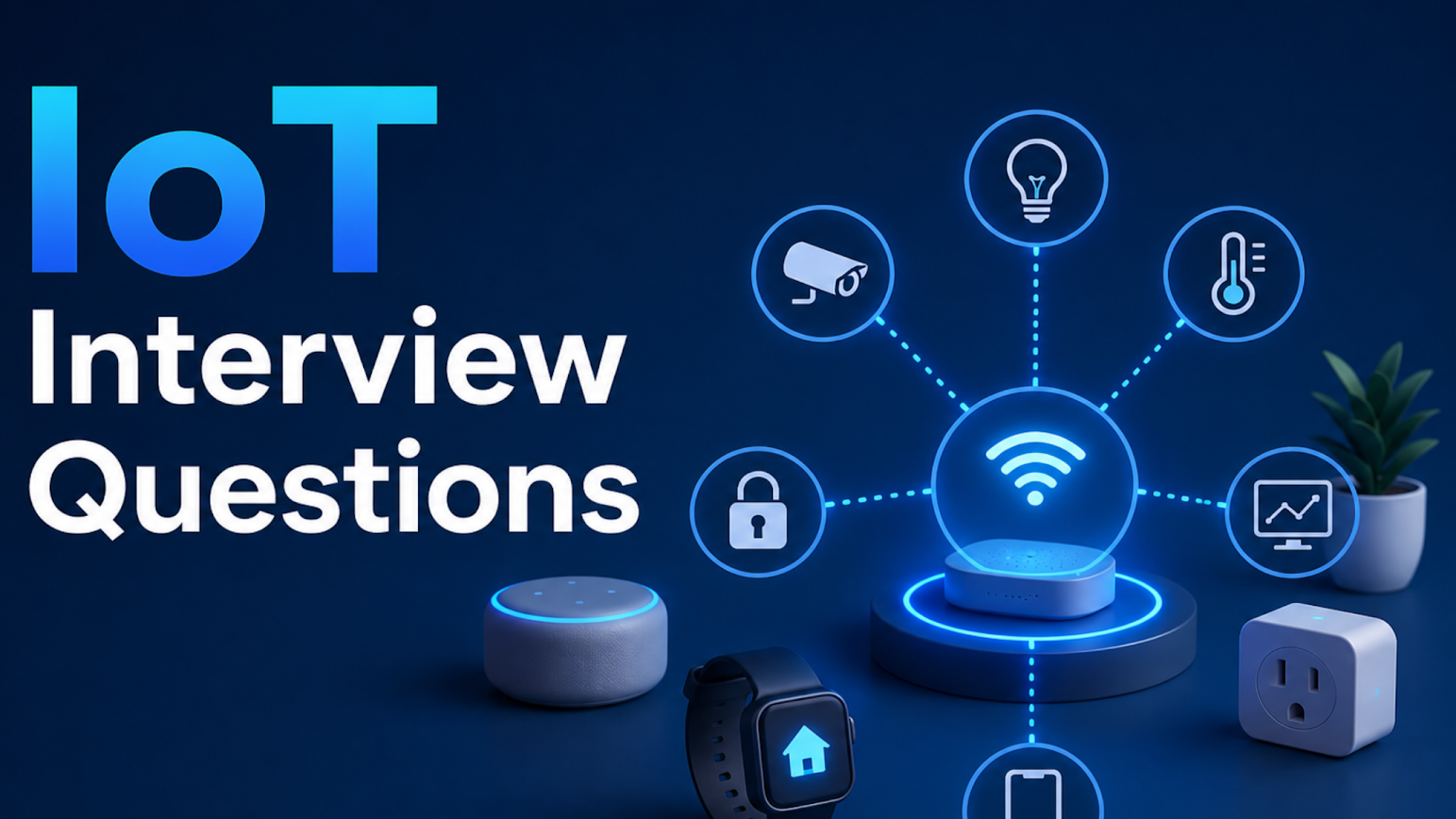
Preparing for an IoT job interview requires a clear understanding of both basic principles and advanced concepts. The Internet of Things is one of the fastest-growing technologies today, connecting devices, systems, and people in ways that were not possible before. Due to this rapid expansion, companies often focus on practical and concept-based IoT interview questions to evaluate your real understanding rather than just theoretical knowledge. In this guide, you will find commonly asked questions from beginner to advanced level, designed to strengthen your preparation and help you feel more confident during interviews. Let’s start with the important IoT interview questions.
Basic IoT Interview Questions for Freshers
1. What is IoT?
IoT (Internet of Things) refers to a network of physical objects that are connected to the internet and can collect, send, and receive data. These devices work together to enable automation and smarter decision-making without constant human involvement.
2. How does IoT work?
IoT works by combining sensors, connectivity, and data processing. First, sensors collect data from the environment, then this data is transmitted through a network, and finally it is processed in the cloud or edge devices to generate useful actions or insights.
3. What are the main components of IoT?
The main components include sensors (to collect data), connectivity (to transfer data), processing systems (cloud or edge computing), and user interfaces (apps or dashboards to control and monitor devices).
4. What is the role of sensors in IoT?
Sensors act as the data collection units in IoT systems. They detect real-world conditions such as temperature, motion, or light and convert them into digital signals for further processing.
5. IoT vs Embedded Systems?
An embedded system is designed to perform a specific task and may or may not be connected to the internet. IoT systems, on the other hand, connect multiple embedded devices through the internet to enable communication and data exchange.
6. What are smart devices?
Smart devices are electronic gadgets that can connect to the internet and perform automated tasks. They can also communicate with other devices and be controlled remotely.
7. What is M2M communication?
Machine-to-Machine (M2M) communication refers to direct interaction between devices without human intervention. It is widely used in automation systems like smart meters and industrial machines.
8. Give examples of IoT applications.
Common examples include smart home systems, wearable fitness trackers, connected cars, smart security cameras, and industrial automation systems.
9. What is the importance of IoT?
IoT improves efficiency, automation, and real-time monitoring. It helps businesses and individuals make better decisions by providing accurate and timely data.
10. What is cloud in IoT?
Cloud in IoT is used to store, process, and analyze large amounts of data collected from devices. It enables remote access, scalability, and advanced analytics.
Intermediate IoT Interview Questions
11. What is IoT architecture?
IoT architecture is a structured framework that defines how data is collected, transmitted, processed, and delivered between IoT devices and applications.
12. What are IoT layers?
IoT typically consists of three main layers: perception layer (data collection), network layer (data transmission), and application layer (user services and interfaces).
13. What is MQTT?
MQTT (Message Queuing Telemetry Transport) is a lightweight messaging protocol designed for IoT systems. It enables efficient communication between devices using minimal bandwidth.
14. Why is MQTT used in IoT?
MQTT is used because it is fast, lightweight, and consumes very little power, making it ideal for devices with limited resources and unstable networks.
15. Difference between HTTP and MQTT?
HTTP follows a request-response model and is heavier in data usage, while MQTT uses a publish-subscribe model, making it more efficient for real-time IoT communication.
16. What is edge computing?
Edge computing processes data closer to the source (device level) instead of sending everything to the cloud, which reduces latency and improves response time.
17. What is fog computing?
Fog computing acts as a bridge between edge devices and the cloud by processing and filtering data locally before sending it to centralized systems.
18. How do IoT devices communicate?
IoT devices communicate using wireless technologies such as Wi-Fi, Bluetooth, Zigbee, LoRa, or cellular networks depending on the application.
19. What is a gateway in IoT?
A gateway is a device that connects IoT sensors and devices to the cloud, ensuring smooth communication by converting different protocols.
20. What is data processing in IoT?
Data processing in IoT involves analyzing raw data collected from devices to extract meaningful insights and trigger automated actions.
Advanced IoT Interview Questions
21. How do you design a scalable IoT system?
A scalable IoT system is designed using cloud infrastructure, distributed architecture, load balancing, and efficient data management techniques to handle increasing devices and data.
22. What are challenges in IoT systems?
Major challenges include data security, scalability, network latency, device compatibility, and managing large volumes of real-time data.
23. How do you reduce latency in IoT?
Latency can be reduced by using edge computing, optimizing network protocols, and minimizing unnecessary data transmission.
24. What is IoT data overload?
It refers to the situation where IoT devices generate more data than the system can efficiently process or store in real time.
25. How do you handle large IoT data?
Large IoT data is handled using cloud storage, real-time analytics tools, data filtering, and distributed processing systems.
26. What is device management in IoT?
Device management involves monitoring, updating, configuring, and maintaining IoT devices remotely throughout their lifecycle.
27. How to improve IoT performance?
Performance can be improved by optimizing communication protocols, reducing data redundancy, using edge computing, and ensuring proper network design.
IoT Architecture Interview Questions
28. Explain IoT architecture.
IoT architecture defines how different components of an IoT system interact with each other to collect, transmit, and process data efficiently.
29. What is perception layer?
The perception layer is the first layer in IoT architecture that consists of sensors and devices responsible for collecting data from the environment.
30. What is network layer?
The network layer is responsible for transferring data from IoT devices to processing systems using communication technologies.
31. What is application layer?
The application layer delivers processed data to end-users in the form of applications like dashboards, alerts, or control systems.
32. What is middleware in IoT?
Middleware acts as a bridge between hardware and software, managing communication, data processing, and system integration.
33. Why is architecture important?
IoT architecture ensures smooth communication, scalability, efficient data flow, and proper system organization.
IoT Sensors and Devices Questions
34. What are sensors?
Sensors are devices that detect physical conditions like temperature, pressure, or motion and convert them into electronic signals.
35. What is an actuator?
An actuator is a device that performs physical actions based on commands received from an IoT system, such as turning a motor on or off.
36. Sensors vs actuators?
Sensors collect data from the environment, while actuators perform actions based on that data.
37. Types of sensors?
Common sensors include temperature sensors, humidity sensors, motion sensors, light sensors, and pressure sensors.
38. How do IoT devices work?
IoT devices collect data through sensors, transmit it through networks, and process it to perform automated actions or provide insights.
39. How are IoT devices powered?
IoT devices are powered using batteries, direct electrical supply, or energy harvesting techniques depending on the use case.
IoT Protocols Interview Questions
40. What are IoT protocols?
IoT protocols are communication rules that allow devices to exchange data efficiently and securely.
41. What is Zigbee?
Zigbee is a low-power wireless communication protocol designed for short-range IoT applications like smart homes.
42. What is BLE?
Bluetooth Low Energy (BLE) is a power-efficient version of Bluetooth used for short-distance communication in IoT devices.
43. Why is CoAP used?
CoAP (Constrained Application Protocol) is used in IoT because it is lightweight and designed for simple devices with limited resources.
44. MQTT vs CoAP?
MQTT is based on a publish-subscribe model and is ideal for real-time messaging, while CoAP uses a request-response model suitable for constrained environments.
45. Which protocol is best for IoT?
There is no single best protocol; it depends on the application, but MQTT is widely preferred for real-time IoT communication.
IoT Security Interview Questions
46. Why is IoT security important?
IoT security is important because connected devices handle sensitive data and can be vulnerable to cyberattacks if not protected properly.
47. What are IoT security challenges?
Challenges include weak authentication, unsecured communication, data leakage, and device hacking risks.
48. How can IoT devices be secured?
Security can be ensured through encryption, strong authentication, regular firmware updates, and secure network protocols.
49. What is encryption?
Encryption is the process of converting data into a coded format to prevent unauthorized access during transmission.
50. What is device authentication?
Device authentication verifies the identity of devices before allowing them to connect to the IoT network.
IoT Cloud and Platform Questions
51. What is IoT cloud?
IoT cloud refers to online platforms used to store, manage, and analyze data generated by IoT devices.
52. Why is cloud used in IoT?
Cloud is used for scalability, real-time processing, remote access, and efficient data storage.
53. Name IoT platforms.
Popular platforms include AWS IoT, Microsoft Azure IoT, and Google Cloud IoT.
54. Role of APIs in IoT?
APIs enable communication between IoT devices, applications, and cloud services.
55. Benefits of cloud in IoT?
Cloud provides flexibility, scalability, centralized control, and advanced analytics capabilities.
Scenario-Based IoT Interview Questions
56. How to build a smart home?
A smart home is built by connecting devices like lights, sensors, and appliances to a central system that can be controlled remotely or automated based on user preferences.
57. Smart traffic system?
It uses sensors and real-time data analytics to monitor traffic flow and adjust signals dynamically to reduce congestion.
58. Handling millions of devices?
This is achieved using scalable cloud infrastructure, distributed systems, and efficient load balancing techniques.
59. Device stops sending data?
The issue is diagnosed by checking connectivity, power supply, sensor health, and network configuration.
60. Improve IoT performance?
Performance is improved by optimizing communication, reducing unnecessary data transfer, and using edge computing for faster processing.
Conclusion
IoT interviews often cover a wide range of topics, from basic concepts and architecture to security, protocols, cloud platforms, and real-world applications. Building a strong understanding of these areas can help you answer questions with confidence and demonstrate your practical knowledge to interviewers. Rather than memorizing answers, focus on understanding how IoT systems work and how different technologies interact within an IoT ecosystem. Regular practice, hands-on projects, and staying updated with industry trends can further improve your chances of success. By reviewing these IoT interview questions and answers, you will be better prepared to tackle both fresher and experienced-level interviews with confidence.