If you assume the strongest graduate outcomes come from big-city campuses, Australia’s national data is a useful reality check. Short-term employment results often favour graduates from regional and remote backgrounds, and several regional institutions consistently perform well on student satisfaction and employer-related measures. The reasons are practical: clearer local skills demand, tighter employer–university ties, more placement-heavy courses, and less competition for entry-level roles in many regional labour markets. For anyone planning australia intake 2026, the takeaway is simple: don’t treat “regional” as a compromise. Use outcomes data, course structure (especially placements), and local job demand to decide what’s right for your goals.
The big shift people miss: outcomes aren’t only about postcode prestige
Australian graduates aren’t entering a single, uniform job market. Outcomes vary by field, location, and how strongly a course connects study with real work. National reporting has also made one thing clearer: the “metropolitan advantage” isn’t automatic.
In 2024, graduate employment softened across the board as the labour market cooled compared with the post-pandemic peak. Full-time employment for domestic undergraduates fell from 79.0% (2023) to 74.0% (2024), and overall undergraduate employment slipped from 88.9% to 86.9%.
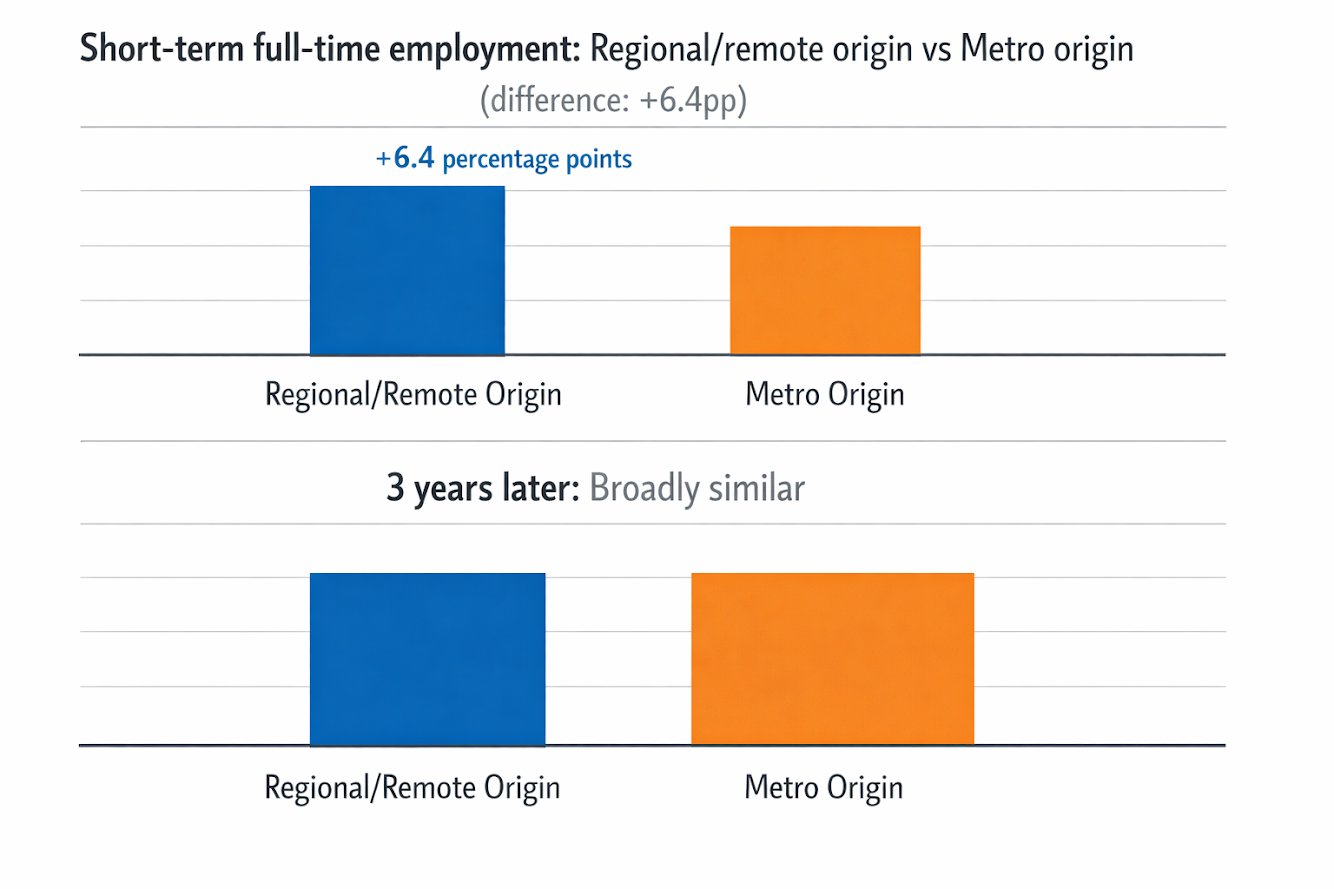
That headline can sound gloomy, but it hides an important detail: graduates linked to regional and remote Australia have often shown stronger short-term full-time employment results than metro peers (depending on the cohort being measured). The Graduate Outcomes Survey—Longitudinal national report notes that domestic undergraduates originally from regional and remote areas had higher short-term full-time employment by 6.4 percentage points, with differences narrowing by three years after graduation.
What “graduate outcomes” really means in Australia
Before we compare regional and metropolitan institutions, it helps to define what is usually counted as “graduate outcomes” in Australian reporting:
- Employment rate
- Full-time employment rate
- Median salary
- Further study
- Graduate satisfaction and employer satisfaction
The QILT program (Quality Indicators for Learning and Teaching) is a major source of nationally comparable results, including the Graduate Outcomes Survey and Employer Satisfaction Survey.
One more nuance: “regional advantage” can mean two different things:
- Where a graduate is from (regional/remote origin), and/or
- Where they studied (a regional campus or regional university)
Those are linked but not identical. A metro student can study regionally; a regional student can study in a city. Good analysis keeps that distinction in view.
The evidence for a regional edge
1) Early career full-time employment can favour regional/remote cohorts
A widely cited comparison from the Australian Government highlighted that graduates from regional and remote areas recorded a full-time employment rate of 83.0%, compared with 77.6% for metropolitan areas (in reporting released in early 2023).
More recent reporting keeps the same theme: short-term differences exist, then tend to narrow over time.
What this suggests: regional pathways can be particularly strong at getting graduates into full-time roles quickly, which matters if your priority is “get hired soon after finishing.”
2) Employer satisfaction with graduates remains high nationally
Employers rating graduates through QILT have reported very strong satisfaction levels. The 2024 Employer Satisfaction Survey summary reports overall satisfaction at 85.5% (the highest since the survey began), and supervisors rated graduate preparedness highly.
This doesn’t prove regional universities “win” by itself, but it matters because many regional institutions build courses around supervised practice, placements, and applied assessment—exactly the things employers tend to reward.
3) Regional universities publicly point to consistent outperformance on satisfaction and outcomes
The Regional Universities Network (RUN) has repeatedly argued that QILT results show strong performance for regional institutions, including pay and employer demand signals, based on the latest available QILT reporting. Treat this as an advocacy lens, but it’s still a useful pointer to where to look in the official datasets.
Why regional universities can beat metro ones on outcomes
A) Regional labour markets can be “less crowded” for graduate entry
In major cities, graduates often compete in deep talent pools for a limited number of formal graduate programs. Regional centres can have smaller pools of candidates, yet still have urgent staffing needs—especially in essential services.
Jobs and Skills Australia’s occupation shortage reporting shows that shortages persist across many roles, and the system tracks where demand is tight.
In practical terms, a graduate with the right qualification in the right regional area can face less competition and faster hiring cycles.
B) Course mix: regional institutions are often strong in “job-direct” fields
Many regional universities have large cohorts in disciplines that map cleanly to local demand:
- Nursing and allied health
- Teaching and early childhood
- Social work and community services
- Agriculture, environmental management, and regional planning
- Trades-adjacent professional pathways and applied STEM
Australia’s teacher shortage has been reported as particularly severe in regional and disadvantaged communities, intensifying the pull for education graduates in those areas.
C) Placements and supervised practice aren’t an add-on — they’re built in
A common metro student complaint is, “I graduated with theory but not enough real work.” Applied learning is not unique to regional universities, but regional institutions often rely on it to serve local industries and services (health, education, local government, agribusiness). That structure can translate into:
- stronger job-ready confidence
- references from supervisors
- clearer hiring pipelines
D) “Stay where you train” is real
In many professions—teaching, nursing, allied health—students often get hired where they complete placements. Regional placements can become direct recruitment, especially where staffing gaps are persistent.
The “small campus effect”: belonging, support, and the hidden link to outcomes
Graduate outcomes aren’t only about job vacancies. Students who finish on time, build networks, and keep stable part-time work during study are usually in a better position at graduation.
National student experience reporting shows undergrad overall educational experience ratings in 2024 were around the mid-70s, with a gradual recovery since the COVID years.
Regional campuses are often smaller, which can mean:
- easier access to teaching staff
- stronger peer community
- more local support programs
- less “anonymous lecture hall” study
That doesn’t guarantee better outcomes, but it can reduce attrition and improve confidence—both of which show up later in employment.
A reality check: regional success isn’t magic — it’s often selection + structure
If you’re trying to explain the regional edge honestly, you have to acknowledge confounding factors:
- Student profile differences: regional cohorts can include more mature-age students, carers, and people already attached to local employers. Those factors can lift short-term employment results independent of institution quality.
- Study mode: the 2024 GOS national report notes differences in outcomes by study mode, with some externally studying graduates showing higher full-time employment and salaries (there are many reasons for this, including existing work history).
- Field of study: outcomes vary massively by discipline. A metro university might dominate outcomes in one field while a regional one leads in another.
So the smart conclusion is not “regional always wins.” It’s: regional universities can outperform metropolitan ones under the right conditions—especially in job-direct fields with strong placement pathways and regional demand.
A grounded illustration: what strong regional outcomes can look like
Some institutions publish their own snapshots linked to national reporting. For instance, the University of the Sunshine Coast (a regional institution) notes a high proportion of domestic graduates in employment within months of finishing (reported on its Graduate Outcomes Survey information). Treat institution-reported figures as context and cross-check with national datasets, but it shows the kind of outcome pattern regional universities often
How to compare universities for graduate outcomes
People searching for the best universities in Australia often start with global rankings. Rankings can matter for certain paths (research careers, niche global employers), but they’re blunt tools for employment outcomes in Australia.
If your priority is “job soon after graduation,” use a tighter approach to compare universities:
1) Start with national outcomes data, then drill down by course area
Use QILT’s Graduate Outcomes and Employer Satisfaction reporting to check:
- short-term employment and full-time employment
- satisfaction measures
- employer ratings
2) Check placement intensity and where placements happen
Ask these direct questions:
- How many placement hours are required?
- Are placements guaranteed or competitive?
- Where do students typically complete placements (local hospitals, schools, industry sites)?
- What proportion of students get hired where they are placed?
3) Match the local labour market to your course
A regional degree shines most when it feeds into regional demand. Use Jobs and Skills Australia shortage reporting as a clue for where hiring is tight.
4) Look at total cost and time-to-complete
Graduate outcomes improve if you finish on time and avoid excessive paid work hours that disrupt study. Regional living costs can be lower than inner-city costs for many students, which can reduce financial pressure (though housing availability varies widely by town).
What metropolitan universities still do very well
A fair comparison also says where metro campuses often have an edge:
- larger alumni pools in corporate CBD roles
- more big-brand recruiters running structured graduate programs
- wider subject breadth and niche majors
- research profile that can matter for postgraduate research pathways
If your target job is investment banking, top-tier management consulting, or a very niche research lab, a metropolitan institution may still fit better.
What this means for australia intake 2026 decisions
If you’re planning australia intake 2026, here’s the practical takeaway:
- Start with your target occupation and field, then work backwards to the course structure that gets you hired.
- Treat regional universities as a first-choice option if your field relies on placements or regional demand (health, teaching, social services, agriculture, applied STEM).
- Use national outcomes reporting to validate marketing claims.
- If a city campus fits your industry goals, pick it for those reasons—just don’t assume it will automatically beat regional options on employment.
In short: prestige can be useful, but it’s not the same as outcomes. In many cases, the best move is the one that puts supervised practice, employer contact, and local demand on your side.
Sources and editorial note
Key Australian data cited from QILT Graduate Outcomes Survey, QILT Employer Satisfaction Survey, Jobs and Skills Australia occupation shortage reporting, and Australian Government statements.