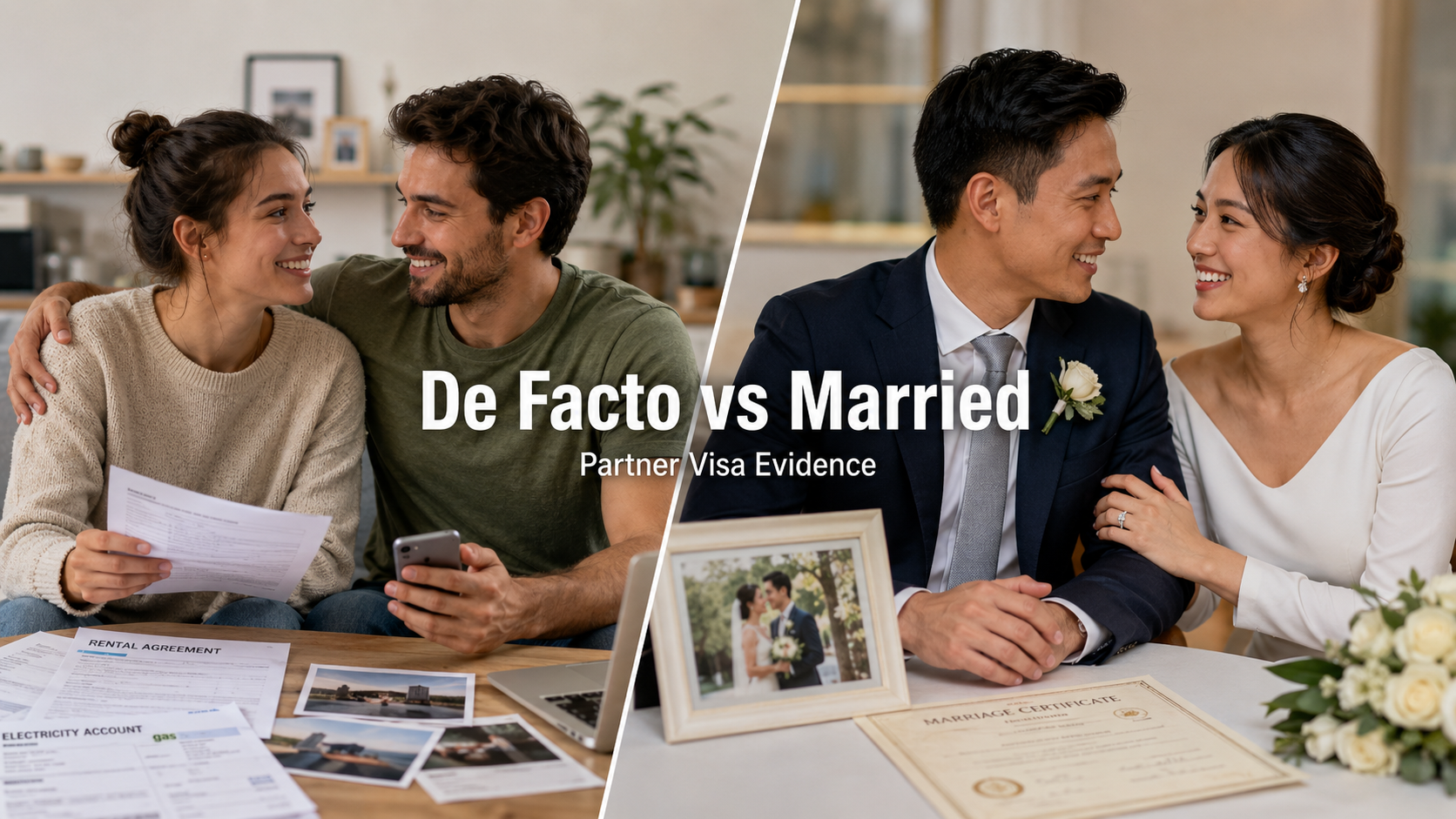
For a partner visa australia application, marriage can prove the legal status of the relationship, but it does not prove the whole relationship. Married and de facto couples must still show a real, continuing, committed relationship. The biggest difference is this: married couples usually start with a marriage certificate, while de facto couples must prove the relationship existed in a marriage-like way before applying. For many de facto applicants, the 12-month rule, shared residence, joint finances, and social proof carry more weight. A strong partner visa application does not rely on one document. It tells a consistent relationship story across legal, financial, household, social, and commitment evidence.
Why the relationship category changes the evidence burden
Australia’s partner visa program covers spouses and de facto partners of Australian citizens, Australian permanent residents, and eligible New Zealand citizens. The main partner visa pathways include the offshore subclass 309/100 pathway and the onshore subclass 820/801 pathway. The temporary or provisional visa is usually the first stage, followed by the permanent stage.
At first glance, married and de facto couples may seem to be assessed in the same way. Both must prove a genuine and continuing relationship. Both must show commitment, shared life, and credibility. The difference lies in the starting point.
A married applicant can rely on a valid marriage certificate to prove the legal relationship. A de facto applicant does not have that single legal marker unless the relationship has been registered under an accepted state or territory scheme. That means the de facto application often needs a more detailed evidence file from the beginning.
What married couples need to prove
A spouse is recognised for migration purposes if the couple is validly married, has a mutual commitment to a shared life as a married couple, has a genuine and continuing relationship, and lives together or does not live apart on a permanent basis.
This means a marriage certificate is important, but it is not enough by itself. The relationship still needs proof across everyday life.
Strong married partner visa Australia evidence often includes:
- Marriage certificate and any required translation
- Wedding photos, invitations, or ceremony records
- Joint bank accounts, shared rent, mortgage, or bills
- Travel records showing time spent together
- Messages, call records, and relationship history
- Evidence of shared address
- Statements from family and friends
- Future plans, such as housing, children, savings, or relocation
For married couples, the common mistake is assuming the certificate closes the case. It does not. A short marriage, long periods apart, limited shared finances, or a wedding soon before lodgement may lead to closer review. The application should explain how the relationship developed before and after marriage.
What de facto couples need to prove
A de facto partner is a person in a relationship with another person, including same-sex and different-sex couples, where the couple is not married but has a mutual commitment to a shared life, the relationship is genuine and continuing, they live together or do not live apart permanently, and they are not related by family.
This makes de facto evidence more fact-heavy. The applicant must prove the relationship operates like a committed couple relationship, even without marriage.
For many de facto partner visa applicants, the key question is not “Do you love each other?” It is “Can the documents prove that your lives are joined?”
Useful de facto evidence often includes:
- Lease agreements, utility bills, or mail at the same address
- Joint bank statements and shared expenses
- Rent transfers, grocery payments, insurance, or household purchases
- Relationship registration, if available and accepted
- Photos across different dates and settings
- Travel records, hotel bookings, and tickets
- Statements from relatives, friends, housemates, or colleagues
- Proof of shared care for pets or children
- Emergency contact records, superannuation nominations, or wills
- Evidence explaining any time spent living apart
The de facto file should show a clear timeline. Dating, visiting, chatting online, and travelling together can support the story, but they may not always prove a de facto relationship by themselves.
The 12-month rule for de facto partner visa applicants
A major difference for de facto couples is the 12-month requirement. Under the Migration Regulations, if a person claims to be in a de facto relationship for certain visa applications, including Partner (Provisional) and Partner (Temporary) visas, the Minister must be satisfied the applicant has been in the de facto relationship for at least 12 months ending immediately before the application date, unless specific exceptions apply.
This does not mean every de facto couple must wait 12 months in every case. Exceptions can apply, including compelling and compassionate circumstances, certain humanitarian-linked situations, or a registered relationship recognised under the relevant law.
Still, applicants should treat the 12-month rule with care. The relationship start date should be realistic and backed by evidence. A first date, first message, or first holiday may not be the same as the start of the de facto relationship. The stronger date is usually when the couple began living as committed partners with shared responsibilities.
The four evidence areas both couples must address
For both married and de facto couples, decision-makers assess all circumstances of the relationship. The key areas are financial aspects, household arrangements, social aspects, and commitment to each other.
1. Financial evidence
Financial evidence shows how the couple shares money and responsibility. Married couples may have clearer records after marriage, while de facto couples often need documents showing financial sharing before lodgement.
Good evidence may include joint accounts, shared bills, rent payments, major purchases, loan documents, insurance, money transfers, or shared budgeting. If one partner pays most expenses, explain why. Unequal income does not damage a genuine case if the arrangement makes sense.
2. Household evidence
Household evidence shows how the couple lives day to day. This can include lease documents, mail to the same address, utility bills, housework arrangements, children’s care, pet care, and statements from people who have visited the home.
For de facto couples, this area is often critical. If the couple has lived apart due to study, work, cultural reasons, family duties, illness, or visa limits, the application should explain the separation and show contact, visits, and ongoing plans.
3. Social evidence
Social evidence shows how others know the relationship. This may include family events, holidays, public photos, invitations, messages with relatives, and statements from people who know the couple.
Form 888 is often used for supporting statements. The person completing it should know the applicant and partner, understand the relationship history, and explain why they believe the relationship is genuine and continuing.
4. Commitment evidence
Commitment evidence shows long-term intention. This may include future housing plans, shared savings goals, fertility or parenting plans, wills, superannuation nominations, long-term travel plans, or records showing emotional support during difficult times.
This evidence should feel personal but still professional. A clear relationship statement can explain how the couple met, when the relationship became serious, how they manage finances, how families are involved, and what they plan next.
Visual guide: married vs de facto evidence focus
Married partner visa: legal marriage proof + ongoing relationship proof
De facto partner visa: relationship timeline + 12-month proof or exception + shared life proof
Both: financial records, household records, social proof, long-term commitment, consistent statements
This kind of comparison works well as an infographic because applicants can quickly see that marriage changes the starting evidence, not the need to prove a real relationship.
Common evidence gaps that cause concern
The most common issue is inconsistency. Dates in personal statements should match travel records, photos, leases, and bank records. If one statement says the couple moved in together in March but the lease starts in July, explain the gap.
Another issue is overloading the file with weak evidence while missing stronger proof. Ten selfies from one holiday may be less useful than one lease, three months of shared bills, and clear statements from people who know the relationship well.
False or misleading material is a serious risk. Partner visa laws include offences linked to arranged marriages, pretended de facto relationships, and unsupported statements. Penalties can be severe.
Final takeaway
The difference between de facto and married partner visa evidence is not about one relationship being stronger than the other. It is about proof. Married couples must prove the marriage is valid and the relationship is real. De facto couples must prove the relationship has the depth, duration, and shared life expected of a committed partnership.
A well-prepared partner visa application should be honest, consistent, and organised by evidence type. For de facto applicants, the timeline and 12-month evidence need special care. For married applicants, the marriage certificate should be treated as the start of the evidence file, not the whole case.