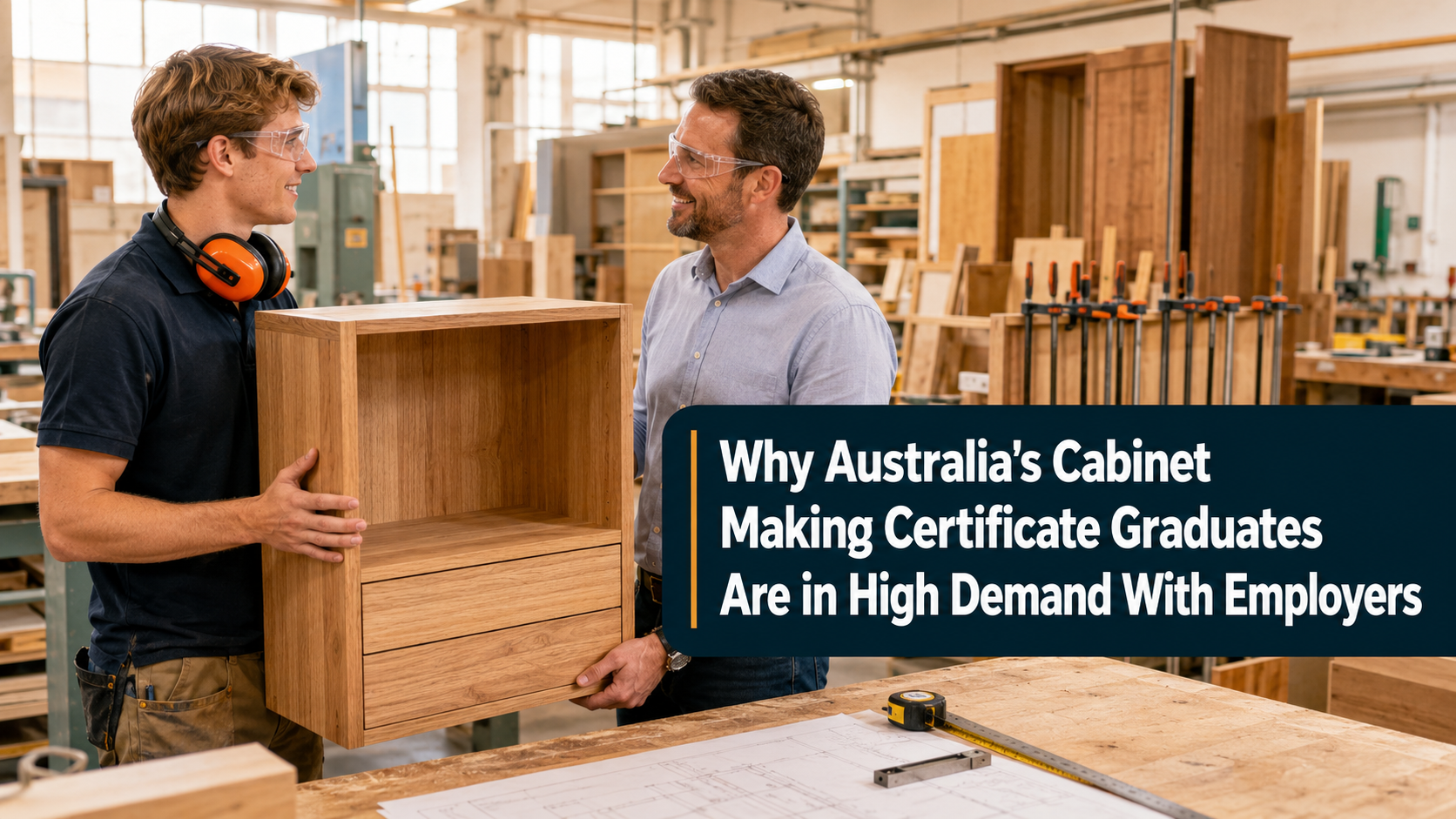
Australia’s cabinet making graduates are becoming highly attractive to employers because the trade sits at the centre of housing, renovation, furniture, shopfitting and interior fit-out work. The current qualification, commonly known by students as a certificate iii in cabinet making or certificate 3 in cabinet making, builds job-ready skills in measuring, cutting, assembling, finishing and installing cabinetry. With Cabinet Maker still rated in shortage in 2025 and Australia aiming for 1.2 million new homes over five years, employers need people who can move from training into workshops, factories and sites with confidence.
A Trade Sitting Right Where Australia Needs Workers
Walk into any new apartment, townhouse, café, medical clinic or renovated family home and one trade leaves a mark in almost every room: cabinet making. Kitchens, vanities, wardrobes, laundries, office fit-outs, reception counters, retail displays and custom storage all rely on trained cabinet makers.
That is why graduates with a cabinet making qualification are finding strong employer interest. The demand is not built on one trend. It comes from a mix of housing targets, renovation activity, a shortage of skilled trades and rising expectations for better interiors.The craftsmanship developed through cabinet making is also highly valued in commercial workspace projects, where an experienced Office Interior Designer Crewe can incorporate bespoke joinery and furniture into functional, modern office environments.
Jobs and Skills Australia reports around 30,500 cabinetmakers employed nationally, with median weekly earnings of $1,400 and a low part-time share of 7%, suggesting the occupation is largely full-time and trade-based. The role covers drawing interpretation, timber and veneer selection, cutting, shaping, assembling, fitting hardware and repairing furniture.
The Certificate Is Practical, Not Just Academic
Employers value the certificate iii in cabinet making because it is built around trade-level performance. The current national qualification is MSF30322 Certificate III in Cabinet Making and Timber Technology, which develops skills for manufacturing and installing furniture and cabinetry using timber and other materials.
That practical focus is a major reason graduates stand out. A business hiring a graduate is not only getting someone who has read about materials. They are hiring someone trained to measure accurately, read plans, prepare components, use machinery, assemble cabinetry and work to deadlines.
In a workshop, a few millimetres can separate a clean installation from a costly remake. Employers need graduates who can work with drawings, communicate with supervisors, follow safety rules and understand how a job moves from concept to completed fit-out.
Housing Targets Are Lifting Demand for Interior Trades
Australia’s housing pipeline is one of the strongest reasons cabinet making graduates are in demand. National Cabinet agreed to a target of 1.2 million well-located homes over five years from 1 July 2024. Every new dwelling needs kitchens, bathrooms, laundries, wardrobes and storage solutions.
Cabinet makers are often thought of as furniture workers, but modern cabinet making is deeply tied to residential construction. Builders need kitchen and bathroom installers. Developers need wardrobe and storage fit-outs. Renovators need custom cabinetry to make smaller homes work harder.
Even with month-to-month movement in construction approvals, the Australian Bureau of Statistics reported 17,300 total dwellings approved in March 2026 on a seasonally adjusted basis, with the trend estimate up 13.1% year-on-year. That kind of activity keeps pressure on the trade pipeline.
A new home is not complete once the walls are standing. Cabinetry is part of the finished product buyers see and use every day. Employers need trained workers who can help projects reach handover without delays.
Cabinet Maker Is Still Rated in Shortage
The clearest signal for job demand is the national skills shortage rating. In the 2025 Occupation Shortage results, Cabinet Maker remained rated as “Shortage.” The broader shortage results also found 29% of assessed occupations were in national shortage in 2025.
For graduates, this does not mean every applicant gets hired instantly. Employers still want reliability, site readiness, clean workmanship and a good attitude. It does mean trained graduates are entering a market where many businesses are already looking for capable hands.
In practical terms, shortage conditions can create more openings across small joinery firms, kitchen companies, furniture workshops, commercial fit-out businesses and renovation teams. It can also push employers to invest in apprentices and early-career tradespeople rather than waiting for fully experienced workers who may be hard to attract.
Employers Need People Who Can Work Across Workshop and Site
Cabinet making has changed. A graduate may start in a factory cutting board, move to assembly, then assist on site with installation. That flexibility is valuable.
Modern cabinet makers can work with solid timber, veneers, particleboard, MDF, laminates, engineered stone coordination, hardware systems and synthetic surfaces. They may also use CNC machinery, edge banders, panel saws, CAD drawings and digital production notes.
This mix of traditional craft and technical production gives certificate graduates an advantage. Employers are not only hiring for hand skills. They need workers who can follow technical instructions, use equipment safely, reduce material waste and keep a job moving.
A graduate who understands both bench work and installation becomes useful quickly. They can help with cabinet assembly on Monday, load and check components on Tuesday, then support a kitchen fit-out later in the week.
Renovations Keep the Trade Busy Between New Builds
New housing is only one part of demand. Renovation work also feeds the need for cabinet makers. Kitchens and bathrooms are among the most common high-value upgrades in Australian homes because they change how a property feels, functions and sells.
Older homes often need smarter storage, better laundry layouts, new vanities, built-in wardrobes or custom entertainment units. Apartments need space-saving cabinetry. Regional homes may need durable materials suited to climate and lifestyle.
This is where a qualified graduate can become very useful to employers. Renovation work often requires problem-solving. Walls may not be square. Floors may not be level. Services may sit in awkward spots. Cabinet makers need to adjust, measure again and find a clean solution without wasting material.
The certificate pathway supports this practical judgment by exposing learners to tools, drawings, materials, assembly methods and installation requirements. For employers, that means less time teaching the basics from scratch.
Commercial Fit-Outs Add Another Hiring Channel
Cabinet making demand is not limited to homes. Cafés, offices, clinics, schools, hotels, gyms and retail stores all need joinery. Commercial interiors often have tight deadlines, custom finishes and high standards for durability.
A medical clinic may need reception counters and storage. A restaurant may need service stations and banquette seating. A retailer may need display units that look good and withstand daily use. A school may need storage that is safe and hard-wearing.
Graduates with a certificate 3 in cabinet making can move into these spaces because their core skills apply across sectors. They can read plans, prepare materials, build components and assist with installation. That cross-sector value makes them more resilient in the job market.
Employers like trade graduates who can move between residential and commercial work because project flow can change. A business may have two kitchen jobs one month and a shopfitting contract the next. Adaptable workers help firms accept more work.
Why Employers Prefer Qualified Graduates
Hiring untrained workers can be expensive. Mistakes in cabinet making cost time, materials and reputation. A wrong cut, damaged panel or poorly fitted hinge can delay a job and reduce profit.
Qualified graduates bring a stronger base. They are more likely to understand safe tool use, measurement accuracy, workshop communication, material handling and quality checks. They also know that presentation counts. Cabinetry is visible work. Clients see uneven gaps, poor finishes and rough installation.
Employers also value graduates because training signals commitment. A person who completes a certificate iii in cabinet making has put time into the trade. That gives employers more confidence when offering further training, mentoring or a longer-term role.
For apprentices, the certificate also forms part of a recognised trade pathway. For experienced workers, formal recognition can help prove skills already gained on the job.
Technology Has Raised the Skill Bar
Some people assume cabinet making is only hand tools and timber dust. In reality, the trade now uses digital drawings, cutting software, CNC machinery and advanced hardware systems. This does not remove the need for skilled workers. It raises the value of workers who can combine craft with technology.
Machines can cut with precision, but people still need to interpret plans, check measurements, choose materials, manage defects, assemble cleanly and install accurately. Technology reduces some manual tasks, but it also creates demand for workers who can think through the whole job.
Graduates who are comfortable with drawings, numbers, machinery and teamwork can become productive faster. Employers want people who can learn new systems without losing the craft discipline that makes cabinetry look and function properly.
A Career With Multiple Pathways
One reason cabinet making graduates stay attractive is the range of roles connected to the trade. A graduate might begin as an apprentice cabinet maker, workshop assistant or installer, then move into kitchen and bathroom cabinetry, furniture making, shopfitting, drafting, CNC operation, project coordination or self-employment later in their career.
The trade suits people who like practical work, visible results and a mix of precision and creativity. It also suits problem-solvers. Every project has constraints: budget, space, material choice, client preference and building conditions.
For employers, that career depth is useful. A strong graduate can grow into a senior tradesperson, installer, leading hand or production supervisor. In a shortage market, businesses are thinking about future staff as much as today’s vacancy.
Final Takeaway
Australia’s cabinet making certificate graduates are in high demand because they sit at the meeting point of housing supply, renovation demand, commercial interiors and skilled trade shortages. The qualification gives employers something they urgently need: people with practical, trade-level skills who can contribute in workshops and on sites.
The certificate iii in cabinet making remains a strong pathway for people who want a hands-on career with real employer needs. For anyone comparing a certificate 3 in cabinet making, the key is to choose training that builds genuine workplace skills, not just a credential. In a market where Cabinet Maker is still rated in shortage, capable graduates have a clear chance to build steady, skilled and respected careers.