Science helps students understand everyday things, including food, plants, animals, electricity, and the natural environment. For Class 6 students, practising previous-year question papers is a useful way to revise concepts and prepare for annual examinations.
The 6th standard science question paper 2018 helps students practise different question types, understand the exam pattern, and identify important topics. In this article, you will find questions from an available 2017–18 model paper, additional practice questions with answers, important chapters, and preparation tips to help you prepare for your Science examination.
6th Standard Science Question Paper 2018: Exam Pattern and Questions
Class 6 Science question papers vary across schools and education boards. One relevant example is the Delhi Directorate of Education’s Class VI (Pratibha) Annual Examination Model Paper for the 2017–18 session.
The paper covers topics such as light, magnets, plants, electricity, fibres, and living organisms.
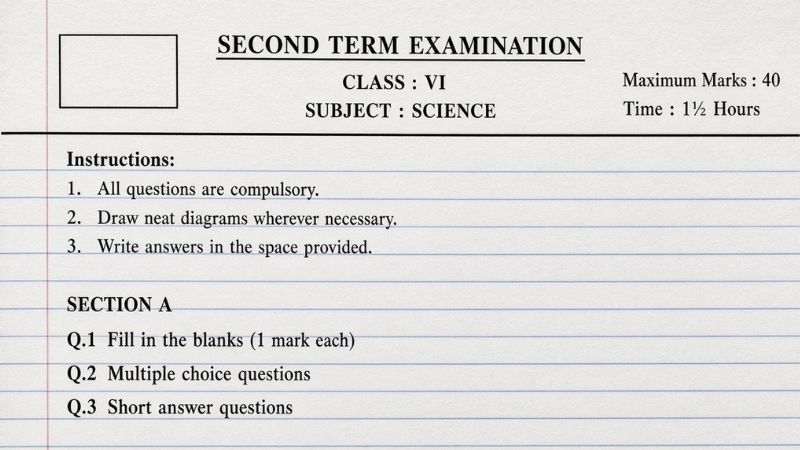
Class 6 Science Question Paper: Exam Details
| Particulars | Details |
| Class | VI (Pratibha) |
| Subject | Science |
| Session | 2017–18 |
| Duration | 2 hours 30 minutes |
| Maximum Marks | 50 |
| Total Questions | 20 |
| Sections | A, B, C and D |
Marks Distribution
| Section | Questions | Marks per Question | Total |
| A | 1–5 | 1 | 5 |
| B | 6–11 | 2 | 12 |
| C | 12–17 | 3 | 18 |
| D | 18–20 | 5 | 15 |
| Total | 20 | — | 50 |
Important Questions from the 2017–18 Class 6 Science Paper
The following are examples of questions taken from the available Delhi annual examination model paper:
- How are we able to see our face in the mirror?
- What kind of adaptation in fish helps in swimming?
- In which direction does a freely suspended magnet align itself?
- Where is a shadow formed in a dark room?
- Name a plant fibre that is obtained from the stem of plants.
- Show the direction of current in an electric circuit and identify the terminals of a cell.
- Differentiate between magnetic and non-magnetic materials with one example each.
- Why is it not advisable to breathe through the mouth?
- What are the factors that affect the growth of seeds into young plants?
- What are the five common characteristics of living organisms?
These questions test your understanding of basic scientific concepts rather than your ability to memorise long answers. For example, you should understand why fish have streamlined bodies, how a magnet behaves when freely suspended, and how light produces shadows.
Another useful reference is the Delhi Directorate of Education’s 2018–19 Class VI Science sample paper. It includes questions about luminous objects, conductors and insulators, spinning, magnets, air composition, and the formation of shadows.
Remember: A model paper from the 2017–18 academic session and a sample paper from 2018–19 are different documents. Neither should automatically be presented as the original annual examination paper of every school in 2018.

Class 6 Science Question Paper with Answers
Practising questions with answers helps you understand how to write accurate responses in your examination. You should pay attention to the wording of each question and provide the information it asks for.
The following Class 6 Science practice questions cover several important topics from the traditional NCERT syllabus.
Multiple-Choice Questions (MCQs)
Choose the correct option for each question.
- Which nutrient is mainly responsible for the growth and repair of body tissues?
- A. Carbohydrates
- B. Proteins
- C. Fats
- D. Water
Answer: B. Proteins
- Which part of a plant absorbs water and minerals from the soil?
- A. Leaf
- B. Flower
- C. Root
- D. Fruit
Answer: C. Root
- Which of the following is a natural plant fibre?
- A. Nylon
- B. Polyester
- C. Cotton
- D. Plastic
Answer: C. Cotton
- Which instrument helps you identify directions?
- A. Thermometer
- B. Compass
- C. Microscope
- D. Barometer
Answer: B. Compass
- Which of these materials is attracted by a magnet?
- A. Wood
- B. Plastic
- C. Iron
- D. Rubber
Answer: C. Iron
- What is necessary for the formation of a shadow?
- A. A source of light
- B. An opaque object
- C. A screen or surface
- D. All of the above
Answer: D. All of the above
- Which gas is present in the largest proportion in the air?
- A. Oxygen
- B. Nitrogen
- C. Carbon dioxide
- D. Hydrogen
Answer: B. Nitrogen
Very Short Answer Questions
- What is a balanced diet?
A balanced diet contains all essential nutrients, including carbohydrates, proteins, fats, vitamins, and minerals, in appropriate amounts.
- Name two plant fibres.
Cotton and jute are two commonly used plant fibres.
- What is photosynthesis?
Photosynthesis is the process through which green plants prepare their food using sunlight, water, and carbon dioxide.
- What is a habitat?
A habitat is the natural environment where an organism lives and obtains the resources it needs to survive.
- What is a magnetic material?
A magnetic material is a substance that is attracted by a magnet. Iron and nickel are common examples.
- Name two transparent materials.
Glass and clean water are examples of transparent materials.
- What is an electric circuit?
An electric circuit is a closed conducting path through which electric current can flow.
Short Answer Questions
- Differentiate between living and non-living things.
Living things perform life processes such as nutrition, respiration, growth, reproduction, and responding to their surroundings. Plants, animals, and human beings are examples of living things.
Non-living things do not perform these life processes. Stones, tables, chairs, and books are examples.
- Why do fish have streamlined bodies?
Fish have streamlined bodies that reduce resistance while moving through water. Their body shape, along with fins and a tail, helps them swim efficiently.
- Differentiate between evaporation and condensation.
Evaporation is the process through which a liquid changes into vapour. It can occur at temperatures below the boiling point.
Condensation is the process through which water vapour changes back into liquid water when cooled. Both processes are important parts of the water cycle.
- Why are different materials used to make different objects?
Different materials have different properties. Metals are commonly used for cooking utensils because they conduct heat. Plastic is used for many household objects because it is lightweight and does not conduct electricity easily.
- Why is a clean environment important for living organisms?
A clean environment provides suitable conditions for plants, animals, and human beings. It helps maintain access to clean air and water, supports healthy habitats, and reduces exposure to harmful pollutants.
Long Answer Questions
- Explain different methods of separating substances.
Different methods are used to separate the components of a mixture. Some common methods include:
- Handpicking: Unwanted materials are removed by hand, such as stones from rice.
- Winnowing: Lighter materials are separated from heavier ones using wind or moving air.
- Sieving: Particles are separated according to their size using a sieve.
- Filtration: Insoluble solids are separated from liquids using a filter.
- Evaporation: A dissolved solid is obtained from a solution by removing the liquid through heating.
These methods are used in everyday activities such as cleaning grains, preparing food, and obtaining salt from seawater.
- Explain the main parts of a plant and their functions.
A plant has several parts that perform different functions.
- Roots: Absorb water and minerals from the soil and hold the plant firmly.
- Stem: Supports the plant and transports water and other substances.
- Leaves: Prepare food through photosynthesis.
- Flowers: Help in plant reproduction.
- Fruits: Protect the seeds and may help in their dispersal.
Each part contributes to the growth and survival of the plant.
- Explain the different types of motion with examples.
Motion refers to a change in the position of an object with time. Some common types include:
- Rectilinear motion: Movement along a straight line, such as a car travelling on a straight road.
- Circular motion: Movement along a circular path, such as the movement of the hands of a clock.
- Periodic motion: Movement that repeats itself at regular intervals, such as the movement of a swinging pendulum.
Some objects can also show more than one type of motion at the same time.
- Explain how a simple electric circuit works.
A simple electric circuit consists of an electric cell, connecting wires, a switch, and a bulb.
When the switch is turned on, it completes the circuit and allows electric current to flow through the wires. The bulb glows if the circuit is properly connected and the components are working.
When the switch is turned off, the circuit becomes open. The current stops flowing, and the bulb goes out.
Important Class 6 Science Chapters to Prepare
Before your examination, revise all the chapters in your school’s syllabus. Pay special attention to these important topics from the traditional NCERT Class 6 Science textbook.
Important Chapters and Topics
- Food: Where Does It Come From? – Sources of food, ingredients, and food habits.
- Components of Food – Nutrients, balanced diet, and deficiency diseases.
- Fibre to Fabric – Cotton, jute, and natural fibres.
- Sorting Materials into Groups – Properties of materials, transparency, and solubility.
- Separation of Substances – Filtration, evaporation, sieving, and winnowing.
- Changes Around Us – Reversible and irreversible changes.
- Getting to Know Plants – Roots, stems, leaves, flowers, and their functions.
- Body Movements – Bones, muscles, skeleton, and joints.
- The Living Organisms and Their Surroundings – Habitats, adaptations, and characteristics of living things.
- Motion and Measurement of Distances – Units of measurement and types of motion.
- Light, Shadows and Reflections – Sources of light, shadows, and reflection.
- Electricity and Circuits – Electric cells, switches, conductors, and circuits.
- Fun with Magnets – Magnetic materials, poles, and directions.
Chapters That Need Extra Revision
Give additional attention to these six chapters:
- Components of Food: Learn nutrients, balanced diets, and deficiency diseases.
- Separation of Substances: Understand different separation methods with examples.
- Getting to Know Plants: Revise plant parts and their functions.
- Body Movements: Learn about bones, muscles, and different joints.
- Light, Shadows and Reflections: Understand shadow formation and reflection.
- Electricity and Circuits: Practise simple circuit diagrams and learn about open and closed circuits.
Revise the complete syllabus rather than preparing only selected chapters.

How to Prepare for the Class 6 Science Examination
Preparing for a Science examination becomes easier when you divide your study time between reading, writing, and revision. Instead of memorising every answer, focus on understanding the concepts and explaining them in simple language.
1. Read Every Chapter Carefully
Start by reading your Science textbook. Pay attention to definitions, examples, diagrams, and activities mentioned in each chapter. If you find a topic difficult, read it again and connect it with an everyday example.
For instance, while studying separation of substances, observe how rice is cleaned or how tea leaves are separated from tea. Such examples make scientific concepts easier to remember.
2. Practise Previous-Year Question Papers
Solve the 6th standard science question paper 2018 without checking the answers. Set a timer and try to complete the paper within the examination duration.
After finishing, check your answers and identify the questions you could not solve correctly. Revise those topics before attempting another Class 6 Science sample paper.
3. Learn Important Definitions
Science examinations often include questions asking you to define basic terms. Prepare short and accurate definitions for concepts such as:
- Photosynthesis
- Habitat
- Balanced diet
- Evaporation
- Condensation
- Magnetic materials
- Transparent objects
- Electric circuit
- Reversible changes
Write each definition in a notebook and revise it regularly.
4. Practise Scientific Diagrams
Some answers become easier to understand when you include a properly labelled diagram. Practise drawing the following:
- Parts of a plant
- Human skeleton
- Simple electric circuit
- Different types of joints
- Structure of a flower
- Seed germination
Keep your diagrams neat and label each part correctly.
5. Revise Textbook Exercises
Do not ignore the questions given at the end of each chapter. They help you check whether you have understood the lesson.
Practise fill-in-the-blanks, multiple-choice questions, short answers, and descriptive questions. You can also ask someone to test you on important definitions and scientific concepts.
Benefits of Solving Previous-Year Science Question Papers
Previous-year papers are useful study materials because they allow you to practise what you have learned. They also help you understand how to manage your time during an examination.
Understand the Examination Pattern
A question paper gives you an idea of how different types of questions are presented. You can practise objective questions, short answers, and long descriptive questions according to the examination format.
Improve Answer-Writing Skills
Knowing an answer is not enough. You should also learn how to present it clearly. Regular writing practice helps you frame complete sentences, use correct scientific terms, and include relevant examples.
Identify Weak Topics
When you solve a question paper, you may find that some chapters are easier than others. For example, you might remember plant parts but struggle with electricity and circuits. This helps you decide which topics need additional revision.
Manage Examination Time
Practising a paper within a fixed duration teaches you how to distribute your time among different sections. You can avoid spending too long on a single question and leave enough time to check your answers.
Improve Confidence
Solving questions independently helps you understand your preparation level. As you become familiar with different question formats, you can approach your examination with better preparation.
Common Mistakes to Avoid in Class 6 Science Exams
Even when you understand the chapters, a few common mistakes can affect your examination performance. Pay attention to how you read questions, frame answers, and manage your time.
- Memorising Without Understanding: Learning answers word for word may not help when questions are presented differently. Understand scientific concepts so you can explain them in your own words.
- Writing Incomplete Answers: Read every question carefully and include all the information it asks for. If a question asks for three examples, make sure you provide all three.
- Ignoring Scientific Diagrams: Diagrams are an important part of Science. Practise drawing them neatly and labelling the correct parts instead of leaving diagram-based questions unanswered.
- Confusing Similar Concepts: Students sometimes mix up evaporation and condensation or transparent and translucent materials. Learn the differences with suitable examples.
- Not Revising Textbook Exercises: Practising only sample papers is not enough. Complete the textbook exercises and revise the important questions from every chapter.
- Poor Time Management: Do not spend too much time on a single question. Complete the easier questions first, then return to the questions that require more thought.
Wrapping Up
Preparing for a Science examination requires regular revision and sufficient writing practice. The 6th standard science question paper 2018 can help you become familiar with examination-style questions and revise important concepts from the Class 6 Science syllabus.
Make sure you understand the chapters, practise textbook exercises, and solve sample papers within a fixed time. Pay attention to scientific definitions, diagrams, and examples while writing your answers. Also, remember that previous-year papers are practice resources, not a guarantee that the same questions will appear in your next examination. With consistent preparation and regular revision, you can develop a better understanding of Science and approach your examination with confidence.
Frequently Asked Questions
Q1. How to download the 6th standard science question paper 2018?
You can search for the 2018 Class 6 Science question paper on school websites, state education portals, and educational websites. Check that the paper matches your board or school.
Q2. What are the important questions for Class 6 Science?
Important questions usually cover food and nutrients, separation methods, plant parts, human body movements, light, electricity, and magnets.
Q3. What is the exam pattern for Class 6 Science?
The exam pattern depends on the school or education board. It may include MCQs, fill-in-the-blanks, short-answer questions, long-answer questions, and diagrams.
Q4. Where can I get Class 6 Science question papers with answers?
You can check educational websites and school portals for solved previous-year papers, sample papers, and answer keys.
Q5. How many chapters are there in Class 6 Science?
The traditional NCERT Class 6 Science textbook Science contains 16 chapters. However, chapter names and syllabus coverage may vary by academic year and curriculum.
Q6. How can I score good marks in Class 6 Science?
Understand textbook concepts, learn important definitions, practise diagrams, revise chapter exercises, and solve sample papers regularly.