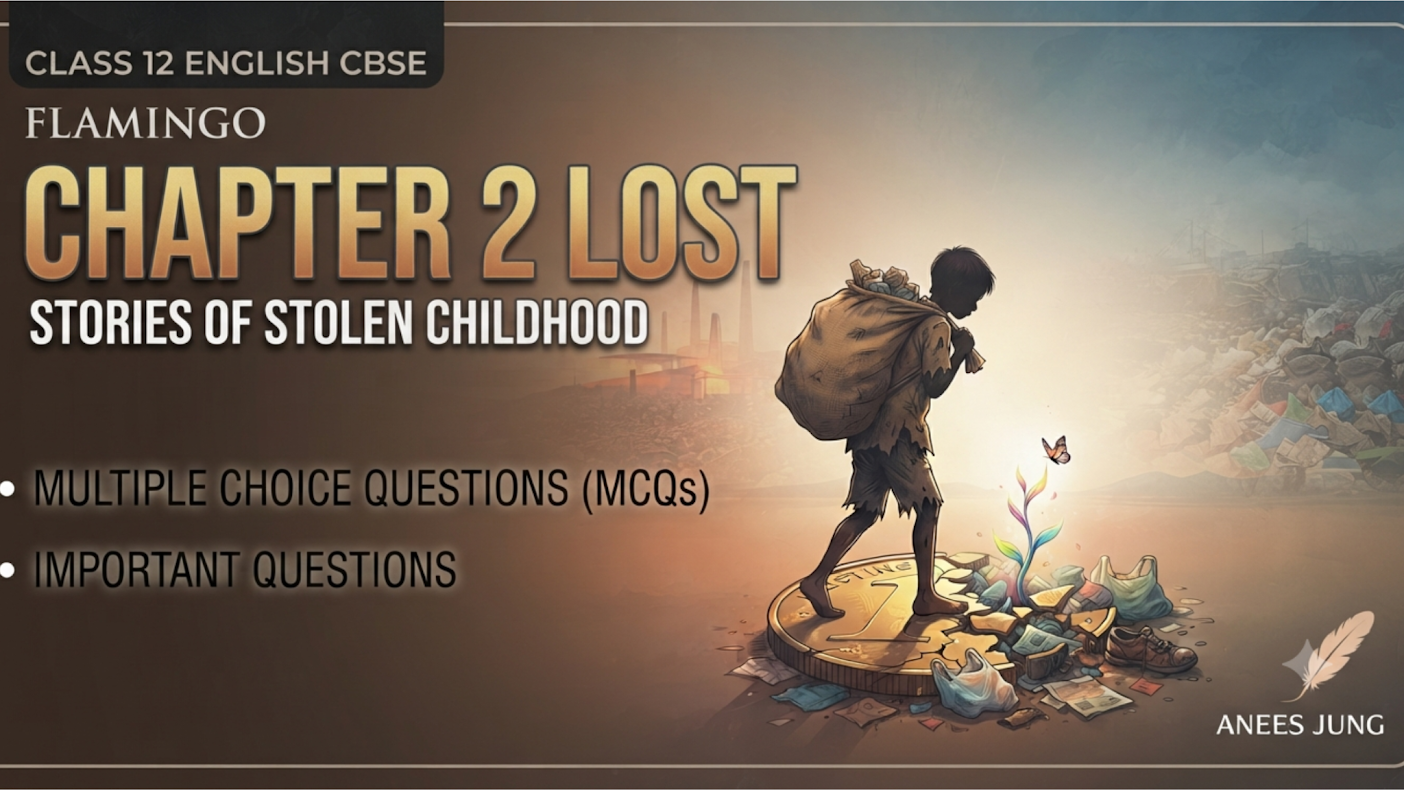
Lost Spring: Stories of Stolen Childhood is an important prose chapter from Class 12 English Flamingo. Written by Anees Jung, the chapter presents the lives of Saheb-e-Alam and Mukesh, two children whose lives are shaped by poverty, child labour and limited opportunities.
These Lost Spring MCQs cover the important facts, characters, incidents, vocabulary, themes and exam-oriented inferences from the chapter. The set includes questions on Saheb’s life in Seemapuri, his work as a ragpicker and later at a tea stall, Mukesh’s dream, the bangle makers of Firozabad, the title of the chapter and its central ideas.
50 Most Important Lost Spring MCQs
1. Who is the author of Lost Spring?
A. Louis Fischer
B. Anees Jung
C. Alphonse Daudet
D. Selma Lagerlöf
Answer: B. Anees Jung
2. What does the title “Lost Spring” mainly refer to in the chapter?
A. The changing seasons in Delhi
B. The loss of childhood and opportunities
C. The end of winter in Seemapuri
D. The changing weather in Firozabad
Answer: B. The loss of childhood and opportunities
3. What is the full title of the chapter?
A. Lost Childhood
B. Lost Spring: Stories of Stolen Childhood
C. Stories of Poor Children
D. The Lost Children
Answer: B. Lost Spring: Stories of Stolen Childhood
4. Who are the two main children described in Lost Spring?
A. Saheb-e-Alam and Mukesh
B. Franz and Mukesh
C. Saheb and M. Hamel
D. Mukesh and Anees Jung
Answer: A. Saheb-e-Alam and Mukesh
5. What was Saheb-e-Alam doing when the author first noticed him?
A. Selling tea at a stall
B. Playing with other children
C. Searching for valuable things in the garbage
D. Attending school
Answer: C. Searching for valuable things in the garbage
6. Where did Saheb’s family originally come from?
A. Firozabad
B. Delhi
C. Dhaka
D. Lucknow
Answer: C. Dhaka
7. Why did Saheb’s family leave Dhaka?
A. They wanted to find better schools
B. Storms destroyed their fields and homes
C. They wanted to start a business in Delhi
D. They were transferred by the government
Answer: B. Storms destroyed their fields and homes
8. Where does Saheb live after coming to Delhi?
A. Firozabad
B. Seemapuri
C. Noida
D. Gurgaon
Answer: B. Seemapuri
9. What does Saheb do for a living?
A. Makes bangles
B. Works at a tea stall
C. Picks rags from garbage
D. Repairs vehicles
Answer: C. Picks rags from garbage
10. What does the name “Saheb-e-Alam” mean?
A. King of Delhi
B. Lord of the universe
C. Master of the house
D. Lord of the poor
Answer: B. Lord of the universe
11. Why is Saheb-e-Alam’s name ironic?
A. He does not remember his name
B. His grand name contrasts with his powerless and deprived life
C. He belongs to a wealthy family
D. He does not like his name
Answer: B. His grand name contrasts with his powerless and deprived life
12. Why is garbage important to the ragpickers of Seemapuri?
A. It provides them with entertainment
B. It is their means of survival and may contain something valuable
C. It is used to make bangles
D. It provides them with school materials
Answer: B. It is their means of survival and may contain something valuable
13. What does the word “scrounging” mean in the chapter?
A. Sleeping in the open
B. Searching through discarded material
C. Selling household goods
D. Walking without purpose
Answer: B. Searching through discarded material
14. Why does Saheb continue looking through garbage?
A. He wants to become a cleaner
B. He hopes to find something valuable
C. He enjoys working with waste
D. He is preparing for school
Answer: B. He hopes to find something valuable
15. What does garbage mean to the children of Seemapuri?
A. Only useless waste
B. A source of survival and sometimes a source of unexpected valuables
C. A means of education
D. A form of entertainment
Answer: B. A source of survival and sometimes a source of unexpected valuables
16. What does Saheb want to do when the narrator asks him about school?
A. Teach in a school
B. Go to school
C. Open a shop
D. Become a rag dealer
Answer: B. Go to school
17. What does the narrator casually promise Saheb?
A. To buy him a bicycle
B. To open a school
C. To find him a permanent home
D. To give him a job
Answer: B. To open a school
18. What does the narrator realise about her promise to Saheb?
A. She has fulfilled it successfully
B. It was an empty promise that she could not realistically fulfil
C. Saheb does not want to study
D. Saheb has already joined a school
Answer: B. It was an empty promise that she could not realistically fulfil
19. Why is Saheb often seen barefoot?
A. He dislikes wearing shoes
B. His family cannot afford proper footwear
C. He works better without shoes
D. He has lost his school shoes
Answer: B. His family cannot afford proper footwear
20. What does Saheb later receive that the narrator notices?
A. A new school uniform
B. A pair of discarded tennis shoes
C. A new bicycle
D. A pair of leather boots
Answer: B. A pair of discarded tennis shoes
21. What change takes place in Saheb’s life when he starts working at the tea stall?
A. He starts attending school
B. He receives regular wages but loses his earlier freedom
C. He becomes a bangle maker
D. He moves back to Dhaka
Answer: B. He receives regular wages but loses his earlier freedom
22. How much does Saheb earn at the tea stall?
A. ₹500 a month
B. ₹600 a month
C. ₹800 a month
D. ₹1,000 a month
Answer: C. ₹800 a month
23. What does Saheb carry while working at the tea stall?
A. A plastic bag
B. A steel canister
C. A schoolbag
D. A basket of bangles
Answer: B. A steel canister
24. Why does the narrator say that Saheb is “no longer his own master”?
A. He has stopped playing with other children
B. He now works under an employer and has lost the freedom he had while rag-picking
C. He has started going to school
D. He has become responsible for his family
Answer: B. He now works under an employer and has lost the freedom he had while rag-picking
25. What contrast is created between Saheb’s plastic bag and the steel canister?
A. Education and poverty
B. Freedom and employment
C. Childhood and old age
D. Wealth and education
Answer: B. Freedom and employment
26. Where does Mukesh live?
A. Seemapuri
B. Dhaka
C. Firozabad
D. Delhi
Answer: C. Firozabad
27. What is Firozabad known for?
A. Carpet-making
B. Glass-bangle making
C. Automobile production
D. Textile manufacturing
Answer: B. Glass-bangle making
28. What is Mukesh’s family’s traditional occupation?
A. Rag-picking
B. Farming
C. Bangle-making
D. Motor repair
Answer: C. Bangle-making
29. What does Mukesh dream of becoming?
A. A teacher
B. A doctor
C. A motor mechanic
D. A shopkeeper
Answer: C. A motor mechanic
30. Why is Mukesh’s dream important?
A. It shows that he wants to continue his family’s occupation
B. It shows his desire to choose a different future
C. It shows that he wants to leave school
D. It proves that his family owns a garage
Answer: B. It shows his desire to choose a different future
31. What prevents many bangle makers from escaping their traditional occupation?
A. Their lack of interest in other work
B. Poverty, social conditions, exploitation and the continuation of hereditary occupation
C. Their high income from bangle-making
D. Their dislike of education
Answer: B. Poverty, social conditions, exploitation and the continuation of hereditary occupation
32. What are the working conditions in the bangle industry like?
A. Comfortable and well-lit
B. Hot, dark and hazardous
C. Modern and air-conditioned
D. Safe and highly regulated
Answer: B. Hot, dark and hazardous
33. What health problem can result from the poor working conditions described in the chapter?
A. Poor eyesight
B. Hearing loss
C. Memory loss
D. Broken bones
Answer: A. Poor eyesight
34. Which groups are mentioned as part of the system that exploits the bangle makers?
A. Teachers and doctors
B. Middlemen, moneylenders, police, bureaucrats and politicians
C. Farmers and shopkeepers
D. Students and factory owners only
Answer: B. Middlemen, moneylenders, police, bureaucrats and politicians
35. What does the “vicious circle” of the bangle makers refer to?
A. A circular bangle-making technique
B. A continuing cycle of poverty, exploitation and inherited occupation
C. A business partnership
D. A local festival
Answer: B. A continuing cycle of poverty, exploitation and inherited occupation
36. Why do children in Firozabad become involved in bangle-making?
A. They receive excellent professional training
B. Poverty and the family’s traditional occupation draw them into the work
C. They want to become wealthy
D. They are required to work by their schools
Answer: B. Poverty and the family’s traditional occupation draw them into the work
37. What does Mukesh’s grandmother suggest about the family’s occupation?
A. It is a temporary job
B. It is their destiny
C. It is highly profitable
D. It is a government occupation
Answer: B. It is their destiny
38. Which statement best describes the similarity between Saheb and Mukesh?
A. Both are wealthy children
B. Both are affected by poverty and child labour
C. Both work in tea stalls
D. Both live in Seemapuri
Answer: B. Both are affected by poverty and child labour
39. What is the major difference between Saheb and Mukesh?
A. Saheb is a ragpicker, while Mukesh belongs to a family of bangle makers
B. Saheb lives in Firozabad, while Mukesh lives in Seemapuri
C. Both work in the same occupation
D. Mukesh is a ragpicker, while Saheb makes bangles
Answer: A. Saheb is a ragpicker, while Mukesh belongs to a family of bangle makers
40. Which character shows a clear desire to break away from a traditional occupation?
A. Saheb
B. Mukesh
C. Saheb’s mother
D. Mukesh’s grandmother
Answer: B. Mukesh
41. What does the phrase “stolen childhood” suggest in the chapter?
A. Children have lost their toys
B. Poverty and labour have taken away the freedom and opportunities associated with childhood
C. Children have moved away from their friends
D. Children have lost their homes because of migration only
Answer: B. Poverty and labour have taken away the freedom and opportunities associated with childhood
42. Which central issue does Lost Spring highlight?
A. Tourism and migration
B. Child labour, poverty and exploitation
C. Modern education
D. Urban development
Answer: B. Child labour, poverty and exploitation
43. What does Mukesh’s dream represent?
A. Acceptance of his inherited occupation
B. A desire for freedom of choice and a different future
C. A wish to become wealthy through bangles
D. A desire to leave Firozabad permanently
Answer: B. A desire for freedom of choice and a different future
44. Why is education important in Saheb’s story?
A. It could provide him with an opportunity to move beyond rag-picking and child labour
B. It would make him a bangle maker
C. It would guarantee immediate wealth
D. It would help him earn ₹800 a month
Answer: A. It could provide him with an opportunity to move beyond rag-picking and child labour
45. What does Saheb’s change from a plastic bag to a steel canister suggest?
A. He has become wealthy
B. His circumstances have changed, but his new employment has reduced his freedom
C. He has started attending school
D. He has stopped working
Answer: B. His circumstances have changed, but his new employment has reduced his freedom
46. If Mukesh accepts bangle-making without questioning it, which important quality of his character would be missing?
A. His desire to choose his own future
B. His knowledge of Firozabad
C. His family background
D. His interest in glass
Answer: A. His desire to choose his own future
47. Which statement best explains why the title Lost Spring is appropriate?
A. The chapter is set during spring
B. The children lose the freedom, hope and possibilities associated with childhood
C. The characters dislike the spring season
D. The story describes a natural disaster
Answer: B. The children lose the freedom, hope and possibilities associated with childhood
48. Which of the following best explains the author’s purpose in presenting Saheb and Mukesh’s lives?
A. To entertain readers with two fictional adventures
B. To draw attention to the realities of poverty, child labour and restricted choices
C. To promote traditional occupations
D. To compare Delhi and Firozabad as tourist destinations
Answer: B. To draw attention to the realities of poverty, child labour and restricted choices
49. What can be inferred from Mukesh’s determination to become a motor mechanic?
A. He completely accepts his family’s traditional occupation
B. He wants to exercise control over his own future despite his circumstances
C. He wants to become a bangle seller
D. He does not understand his family’s problems
Answer: B. He wants to exercise control over his own future despite his circumstances
50. Which statement best captures the central idea of Lost Spring?
A. Traditional occupations always provide financial security
B. Poverty and social conditions can deprive children of education, freedom and the opportunity to choose their future
C. Children should never work under any circumstances
D. City life is always better than village life
Answer: B. Poverty and social conditions can deprive children of education, freedom and the opportunity to choose their future
Quick Revision: Lost Spring Chapter Notes
| Topic | Important Detail |
| Chapter | Lost Spring: Stories of Stolen Childhood |
| Author | Anees Jung |
| Main characters | Saheb-e-Alam and Mukesh |
| Saheb’s original home | Dhaka |
| Saheb’s settlement | Seemapuri |
| Saheb’s occupation | Rag-picking |
| Meaning of Saheb-e-Alam | Lord of the universe |
| Saheb’s wish | To go to school |
| Saheb’s later job | Tea-stall worker |
| Saheb’s wage | ₹800 per month |
| Mukesh’s hometown | Firozabad |
| Firozabad | Famous for glass-bangle making |
| Mukesh’s dream | To become a motor mechanic |
| Main issues | Poverty, child labour and exploitation |
| Important word | Scrounging |
| Central idea | Loss of childhood and opportunities |
Questions to Revise Before the Class 12 Exam
Apart from practising the Lost Spring MCQ questions above, students should be able to answer these important short-answer questions:
1. Why did Saheb’s family migrate from Dhaka?
2. Why is garbage important to the people of Seemapuri?
3. Why does Saheb want to go to school?
4. Why is Saheb’s name ironic?
5. What is the significance of Saheb’s shoes?
6. Why does Saheb lose his freedom after joining the tea stall?
7. What does the steel canister symbolise?
8. What is Mukesh’s dream?
9. Why does Mukesh want to become a motor mechanic?
10. Why are the bangle makers of Firozabad unable to escape poverty?
11. What is meant by the “vicious circle” in the chapter?
12. How are Saheb and Mukesh similar?
13. How are their lives different?
14. Why is the title Lost Spring appropriate?
15. How does the chapter present the problem of child labour?
Conclusion
These 50 Lost Spring MCQs cover the chapter’s most important facts, characters, events, vocabulary, themes and inference-based points. Students should revise the factual questions first and then focus on the questions about Saheb’s loss of freedom, Mukesh’s dream, the bangle makers’ working conditions and the meaning of the title. Understanding these points will also help with short-answer, long-answer and extract-based questions from the chapter.