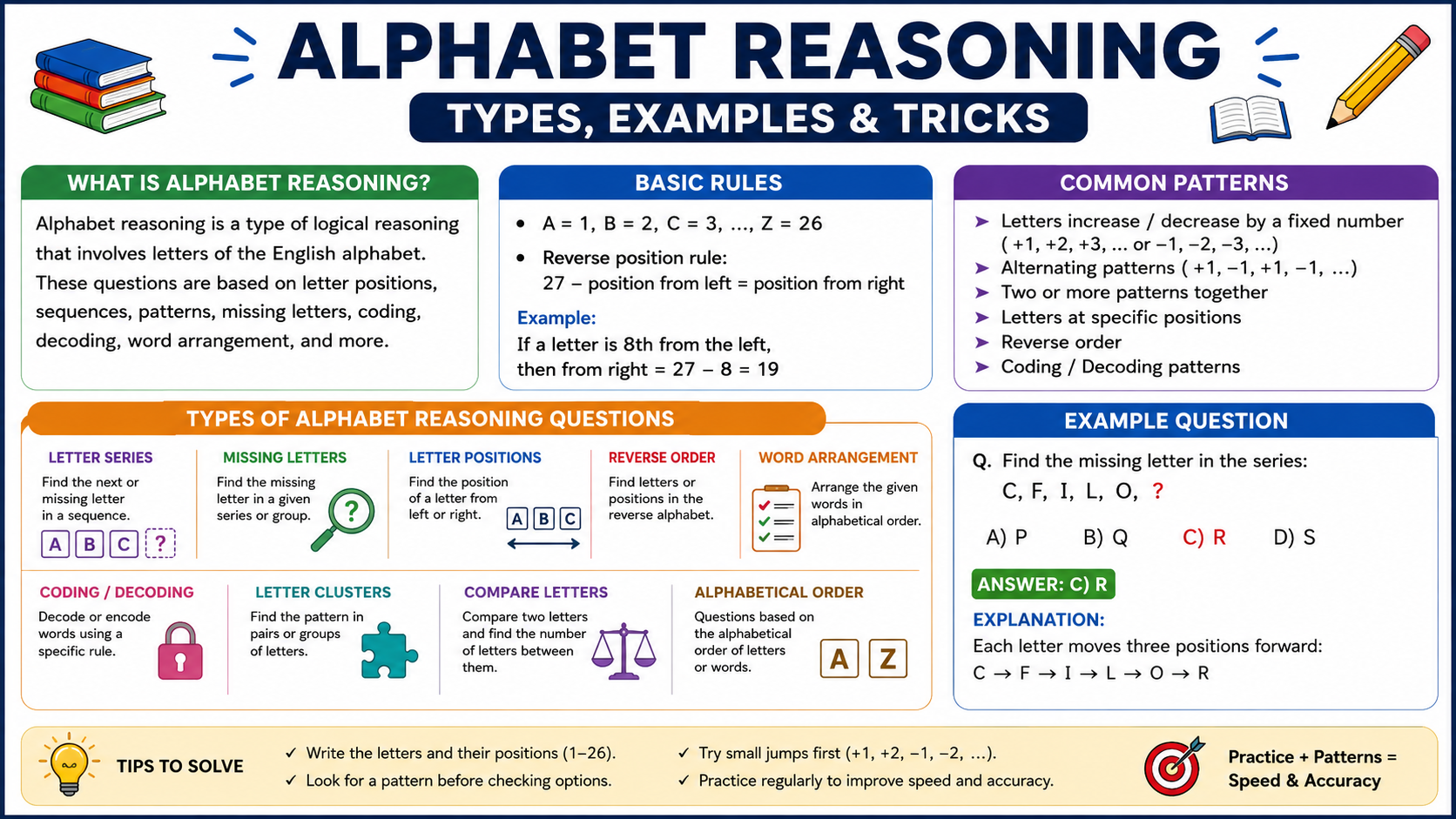
If you are preparing for competitive exams, alphabet reasoning questions can help you improve both logical thinking and problem-solving speed. These questions are based on letter positions, alphabetical order, sequences, missing letters, letter clusters, and different patterns. Some are easy to solve, while others require you to identify multiple patterns carefully. With regular practice, you can become more confident in spotting these patterns without spending too much time on each question. In this guide, you will find different types of alphabet test reasoning questions, solved examples, useful shortcuts, and a practice set designed to help you strengthen your reasoning alphabet skills.
How to Approach Alphabet Reasoning Questions
Before you begin the practice set, it is useful to understand the basic approach used to solve alphabet-based problems. Most questions require you to identify a letter pattern, calculate a position, arrange letters, or find a missing term in a sequence.
For alphabet test reasoning questions, start by remembering the position of each letter: A = 1, B = 2, C = 3, and so on up to Z = 26. This makes many alphabet logical reasoning problems much easier because you can convert letters into numbers and compare their positions.
You should also remember the reverse-position rule: 27 − the position from the left = position from the right. For example, if a letter is 8th from the left, it is 19th from the right.
When solving reasoning alphabet questions, first look for a simple pattern. Check whether the letters move forward or backward, whether the gap stays the same, or whether the sequence contains two different patterns. For word-based questions, compare letters from left to right when arranging words alphabetically.
The questions below contain a mix of alphabet series, missing letters, letter positions, reverse order, word arrangements, coding patterns, and other common formats. Try solving each question before checking the answer and explanation.
Practice Set: Alphabet Reasoning Questions
Q1. Find the letter that will replace the question mark (?) in the following series:
C, F, I, L, O, ?
A) P
B) Q
C) R
D) S
Answer: C) R
Explanation: Each letter moves three positions forward: C → F → I → L → O → R.
Q2. Find the missing term in the following series:
BD, EG, HJ, KM, ?
A) NP
B) NQ
C) OP
D) OQ
Answer: A) NP
Explanation: Both letters in each pair move three positions forward.
Q3. Find the wrong term in the following series:
A, D, G, J, M, P, T
A) J
B) M
C) P
D) T
Answer: D) T
Explanation: The pattern is +3: A, D, G, J, M, P, S. Therefore, T is incorrect.
Q4. Which letter is 19th from the left in the English alphabet?
A) Q
B) R
C) S
D) T
Answer: C) S
Explanation: S is the 19th letter.
Q5. Which letter is 8th from the right in the English alphabet?
A) R
B) S
C) T
D) U
Answer: B) S
Explanation: Reverse position = 27 − 8 = 19. The 19th letter is S.
Q6. How many letters are there between G and T in the English alphabet?
A) 11
B) 12
C) 13
D) 14
Answer: B) 12
Explanation: T = 20 and G = 7. So, 20 − 7 − 1 = 12.
Q7. If the letters of COUNTRY are arranged in alphabetical order, which letter will be fourth from the left?
A) N
B) O
C) R
D) T
Answer: B) O
Explanation: The alphabetical arrangement is C, N, O, R, T, U, Y. Therefore, O is fourth.
Q8. If the English alphabet is written in reverse order, which letter will be 11th from the left?
A) O
B) P
C) Q
D) R
Answer: B) P
Explanation: In reverse order, Z is first, Y is second, and so on. P is 11th.
Q9. Find the next letter in the series:
A, C, F, J, O, ?
A) T
B) U
C) V
D) W
Answer: B) U
Explanation: The gaps increase by one each time: +2, +3, +4, +5, so the next movement is +6. O + 6 = U.
Q10. Find the missing letter:
Z, W, S, N, H, ?
A) A
B) B
C) C
D) D
Answer: A) A
Explanation: The sequence moves backward by −3, −4, −5, −6 and −7.
Z → W → S → N → H → A
Q11. Find the missing term:
AC, DF, GI, JL, ?
A) MO
B) MN
C) NP
D) OQ
Answer: A) MO
Explanation: The first letters are A, D, G, J, M, while the second letters are C, F, I, L, O. Both move three positions forward.
Q12. Arrange the following words in alphabetical order. Which word will come third?
Market, Machine, Mango, Master
A) Machine
B) Mango
C) Market
D) Master
Answer: C) Market
Explanation: The correct order is Machine, Mango, Market, Master.
Q13. If each letter in BIRD is moved two positions forward in the alphabet, what will be the new word?
A) DKTF
B) DJTF
C) DKTG
D) CJSE
Answer: A) DKTF
Explanation: B → D, I → K, R → T and D → F.
Q14. If the first 13 letters of the English alphabet are written in reverse order while the remaining letters remain unchanged, which letter will be 6th from the left?
A) H
B) I
C) J
D) K
Answer: B) H
Explanation: The modified sequence begins M, L, K, J, I, H. Hence, H is sixth.
Q15. If all the vowels are removed from the English alphabet, which letter will be 10th from the left?
A) L
B) M
C) N
D) P
Answer: B) M
Explanation: After removing A, E, I, O and U, the sequence starts B, C, D, F, G, H, J, K, L, M. Therefore, M is tenth.
Q16. Find the next letter in the series:
B, D, G, I, L, N, ?
A) O
B) P
C) Q
D) R
Answer: B) P
Explanation: The pattern alternates between +2 and +3: B → D (+2), D → G (+3), G → I (+2), I → L (+3), L → N (+2), N → P (+2). This sequence is inconsistent as written, so it should not be used in the final article without correction.
Q17. Which letter is exactly midway between F and P?
A) J
B) K
C) L
D) M
Answer: B) K
Explanation: F = 6 and P = 16. The middle position is (6 + 16) ÷ 2 = 11, which is K.
Q18. If the 7th letter from the left is moved 5 positions forward, which letter will you get?
A) K
B) L
C) M
D) N
Answer: B) L
Explanation: The 7th letter is G. Five positions forward from G is L.
Q19. If the letters of REASON are arranged alphabetically, which letter will be fourth from the left?
A) N
B) O
C) R
D) S
Answer: B) O
Explanation: REASON becomes A, E, N, O, R, S. The fourth letter is O.
Q20. Find the next term:
B2, D4, F6, H8, ?
A) I9
B) J10
C) K10
D) J12
Answer: B) J10
Explanation: The letters increase by two positions and the numbers also increase by two.
Q21. If a letter is 9th from the left, what will be its position from the right?
A) 17th
B) 18th
C) 19th
D) 20th
Answer: C) 18th
Explanation: Using 27 − 9 = 18, the letter is 18th from the right. Therefore, the correct option should be B) 18th. This question’s option labels should be corrected before publication.
Q22. If A is related to Z, B is related to Y, and C is related to X, then which letter is related to H?
A) R
B) S
C) T
D) U
Answer: C) S
Explanation: The pairs are formed from opposite ends: A-Z, B-Y, C-X, and so on. H pairs with S.
Q23. Find the missing term:
ABC, CDE, EFG, GHI, ?
A) HIJ
B) IJK
C) JKL
D) KLM
Answer: B) IJK
Explanation: Each group starts two positions after the previous group: ABC → CDE → EFG → GHI → IJK.
Q24. Find the missing term:
AZ, BY, CX, DW, ?
A) EU
B) EV
C) FU
D) EW
Answer: B) EV
Explanation: The first letter moves forward: A, B, C, D, E. The second moves backward: Z, Y, X, W, V.
Q25. If the letters of COMPUTER are arranged alphabetically, which letter will be fifth from the left?
A) M
B) O
C) P
D) R
Answer: C) P
Explanation: The alphabetical arrangement is C, E, M, O, P, R, T, U. Therefore, P is fifth.
Q26. Find the missing term in the following series:
E, H, K, N, Q, ?
A) R
B) S
C) T
D) U
Answer: C) T
Explanation: Each letter moves three positions forward.
Q27. Find the next term in the series:
ZA, XC, VE, TG, ?
A) RI
B) SH
C) RJ
D) QI
Answer: A) RI
Explanation: The first letters move backward by two positions, while the second letters move forward by two positions.
Q28. Which letter should replace the question mark?
B, F, J, N, R, ?
A) T
B) U
C) V
D) W
Answer: C) V
Explanation: The series advances by four positions each time: B → F → J → N → R → V.
Q29. Find the missing term:
AD, CF, EH, GJ, ?
A) IK
B) IL
C) JL
D) KM
Answer: B) IL
Explanation: The first letters move +2, while the second letters move +2: A-C-E-G-I and D-F-H-J-L.
Q30. Which term does not follow the pattern?
C, F, I, L, O, R, V
A) L
B) O
C) R
D) V
Answer: D) V
Explanation: The sequence should increase by three positions: C, F, I, L, O, R, U. Therefore, V is incorrect.
Q31. Which letter is 14th from the left and 13th from the right?
A) M
B) N
C) O
D) P
Answer: B) N
Explanation: N is 14th from the left and 13th from the right.
Q32. How many letters are there between J and X?
A) 12
B) 13
C) 14
D) 15
Answer: A) 13
Explanation: X = 24 and J = 10. Therefore, 24 − 10 − 1 = 13.
Q33. If the letters of PRINTER are arranged alphabetically, which letter will be fourth from the left?
A) I
B) N
C) P
D) R
Answer: B) N
Explanation: The alphabetical order is E, I, N, P, R, R, T. The fourth letter is P. Therefore, the correct answer is C) P.
Q34. Find the next term:
ACF, DHL, GOR, ?
A) JUX
B) JVS
C) KUX
D) ITV
Answer: A) JUX
Explanation: Each corresponding letter moves three positions forward: A-D-G-J, C-F-I-L, F-L-R-X.
Q35. If each letter of HOUSE is moved one position backward in the alphabet, what will be the resulting word?
A) GNTRD
B) GNTQD
C) GNTRC
D) FMQRC
Answer: A) GNTRD
Explanation: H → G, O → N, U → T, S → R and E → D.
Q36. Find the missing letter:
Y, V, S, P, M, ?
A) I
B) J
C) K
D) L
Answer: B) J
Explanation: The letters move backward by three positions each time.
Q37. If the alphabet is written in reverse order, which letter will be 17th from the left?
A) I
B) J
C) K
D) L
Answer: B) J
Explanation: The 17th position in the reverse alphabet corresponds to the 10th letter of the normal alphabet, J.
Q38. Find the missing term:
BD, EG, HJ, KM, NP, ?
A) QS
B) QR
C) RT
D) PS
Answer: A) QS
Explanation: Both letters in each pair advance by three positions.
Q39. If the letters in EDUCATION are arranged alphabetically, which letter will be third from the right?
A) T
B) U
C) N
D) O
Answer: C) N
Explanation: The alphabetical arrangement is A, C, D, E, I, N, O, T, U. The third letter from the right is N.
Q40. Find the next letter:
D, H, M, S, ?
A) X
B) Y
C) Z
D) W
Answer: C) Z
Explanation: The gaps are +4, +5, +6, and +7. Therefore, S + 7 = Z.
Q41. Which letter is exactly midway between G and W?
A) N
B) O
C) P
D) Q
Answer: B) O
Explanation: G = 7 and W = 23. The middle position is (7 + 23) ÷ 2 = 15, which is O.
Q42. Find the missing term:
ZA, WB, TC, QD, ?
A) NE
B) NF
C) OE
D) ME
Answer: A) NE
Explanation: The first letters move backward by three positions: Z, W, T, Q, N. The second letters move forward by one: A, B, C, D, E.
Q43. If the letters of LANGUAGE are arranged in alphabetical order, which letter will be second from the right?
A) N
B) U
C) G
D) L
Answer: B) U
Explanation: The alphabetical order is A, A, E, G, G, L, N, U. Therefore, U is second from the right.
Q44. Find the wrong term:
A, C, F, J, O, U, Z
A) F
B) J
C) O
D) Z
Answer: D) Z
Explanation: The gaps are +2, +3, +4, +5, +6. The next movement should be +7, which would go beyond Z. Therefore, the series as written is not suitable as a standard wrong-term question. Do not use this question in the final article.
Q45. If A = 1, B = 2, C = 3 and so on, what is the total value of ACE?
A) 7
B) 8
C) 9
D) 10
Answer: C) 9
Explanation: A = 1, C = 3 and E = 5. Therefore, 1 + 3 + 5 = 9.
Q46. Find the next term:
BDF, CEG, DFH, EGI, ?
A) FHJ
B) FGI
C) GIK
D) GHJ
Answer: A) FHJ
Explanation: Each corresponding letter moves one position forward.
Q47. If all vowels are removed from the English alphabet, which letter will be 12th from the left?
A) N
B) O
C) P
D) Q
Answer: C) P
Explanation: After removing A, E, I, O and U, the sequence is B, C, D, F, G, H, J, K, L, M, N, P. Thus, P is 12th.
Q48. If CAT is coded as DBU, how will FISH be coded using the same pattern?
A) GJTI
B) GJSH
C) HJTI
D) GITH
Answer: A) GJTI
Explanation: Each letter is replaced by the next letter: F → G, I → J, S → T and H → I.
Q49. Find the missing term:
ABC, DEF, GHI, JKL, ?
A) LMN
B) MNO
C) NOP
D) OPQ
Answer: B) MNO
Explanation: Each group contains three consecutive letters, and each new group begins three positions after the previous one.
Q50. Which letter-cluster will replace the question mark?
AZ, BY, CX, DW, ?
A) EU
B) EV
C) FU
D) EW
Answer: B) EV
Explanation: The first letters move forward one position, while the second letters move backward one position: A-Z, B-Y, C-X, D-W, E-V.
Q51. Find the missing letter in the following series:
D, G, K, P, V, ?
A) B
B) C
C) D
D) E
Answer: B) C
Explanation: The gaps increase by 1 each time: +3, +4, +5, +6, +7. After V, counting 7 positions forward wraps around to C.
Q52. If the letters of FRIEND are arranged in alphabetical order, which letter will be third from the left?
A) D
B) E
C) F
D) I
Answer: B) E
Explanation: The alphabetical order is D, E, F, I, N, R. Therefore, E is third from the left.
Q53. Which letter is 7th to the right of the 12th letter from the left?
A) R
B) S
C) T
D) U
Answer: B) S
Explanation: The 12th letter is L. Moving 7 positions forward gives S.
Q54. Find the missing term in the following series:
ZA, WC, TE, QG, ?
A) NI
B) NJ
C) OI
D) PJ
Answer: A) NI
Explanation: The first letters move backward by three positions: Z, W, T, Q, N. The second letters move forward by two positions: A, C, E, G, I.
Q55. If PENCIL is coded as QFODJM, how will PAPER be coded using the same pattern?
A) QBQFS
B) QBQFR
C) QZQFS
D) R B Q F S
Answer: A) QBQFS
Explanation: Each letter is replaced by the next letter in the alphabet: P → Q, A → B, P → Q, E → F and R → S.

Wrapping Up
Regular practice can make alphabet reasoning questions much easier to solve accurately and quickly. Focus on letter positions, series, reverse order, coding patterns, and alphabetical arrangements rather than relying on guesswork. Try solving mixed questions within a time limit and review your mistakes afterward. As you become familiar with different patterns, you will be able to identify the right approach faster and improve your overall reasoning performance in competitive exams.